Skip to content
  • Categories
  • Recent
  • Tags
  • Popular
  • Users
  • Groups
Skins
  • Light
  • Dark

Collapse
Brand Logo

Forum

I

iteducationsense

@iteducationsense
About
Posts
3
Topics
3
Groups
0
Followers
0
Following
0

Posts

Recent Best Controversial

  • Signavio Process Insights Spot Bottlenecks Inside Live SAP
    I iteducationsense

    In many SAP projects, teams know that a business process is slow. The harder part is finding out why. A sales order may sit too long before delivery. Invoices may wait for approval. Users often blame the system first. In practice, the real issue can be a process step, repeated manual work, or poor master data. Signavio Process Insights helps teams see where these problems happen inside live SAP processes. Beginners can join the Sap Course in Mumbai to learn the best practices from industry experts.

    Finding Problems in Real SAP Processes

    Traditional process reviews often depend on interviews and assumptions. A manager may say that invoice processing takes three days. An analyst may check a few documents and reach a similar conclusion. But this approach can miss what happens across thousands of transactions.

    Signavio Process Insights takes a data-driven approach. It analyses the process information from SAP systems. It then highlights areas that need attention.

    The important word here is live. Instead of looking only at an ideal process diagram, teams can examine what is actually happening in the SAP environment. That difference matters.

    For example, a company may believe that purchase orders move smoothly from creation to approval. Process data might show something else. Some orders could be waiting for approval for several days. Others may go through repeated changes before completion.

    That is a bottleneck. A bottleneck is simply a point where work slows down and creates a queue.

    How Signavio Process Insights Finds Bottlenecks

    Signavio Process Insights examines operational data from SAP and uses process analysis to identify unusual patterns and performance issues.

    A beginner can think about it this way:

    SAP records what happened. Signavio Process Insights helps explain where the process is struggling.

    The tool can surface indicators related to process performance, such as:

    Delays between important process steps
    Large numbers of open transactions
    Repeated changes to documents
    Process deviations
    Unusual transaction patterns
    Issues related to master data

    Activities that require unnecessary manual intervention
    Suppose a manufacturing company processes purchase orders every day. The purchasing team complains that materials arrive late. The first reaction may be to blame suppliers.

    However, process analysis might reveal that purchase orders are created quickly but remain blocked during internal approval. The supplier is not the main problem. The internal approval step is. That is a much more useful finding. Sap Classes in Pune can teach learners how process insights support practical SAP process improvement.

    Bottlenecks Become Easier to Investigate

    One thing that often surprises beginners is how difficult process problems can be to spot from individual SAP transactions.

    A user may open one purchase order and see nothing unusual. Another order may also look normal. The problem becomes visible only when thousands of transactions are viewed together. This is where process insights become valuable.

    Consider an accounts payable team. It receives thousands of invoices each month. Most of the invoices get processed normally. A small group gets stuck because of the missing information or approval issues.

    Without process analysis, employees may spend hours searching for these exceptions. With process insights, teams can identify patterns and focus their investigation on the transactions that create the biggest delays.

    That changes the conversation.

    Instead of saying, “Invoice processing is slow,” the team can ask, “Why are invoices with this condition taking longer to clear?” That question is much easier to act on.

    SAP Course in Delhi can help professionals understand how to analyze SAP workflows and resolve process bottlenecks.

    Connecting Process Problems With Business Impact

    Finding a bottleneck is only the first step. Businesses also need to understand its impact.

    Imagine a company where sales orders frequently require manual changes. Each change takes a few minutes. One transaction does not seem important. Now multiply that effort across thousands of orders. The lost time can become significant.

    Process analysis can help teams connect operational problems with business performance. It offers process owners a clearer view of the areas that have delays, rework, and inefficiencies.

    I have seen this distinction matter in SAP improvement projects. Teams sometimes focus on technical changes because they are easy to discuss. Yet a simple process adjustment can deliver greater value. For example, changing an approval rule may reduce the waiting time more than the time needed to modify a technical component.

    Turning Insights into SAP Improvements

    Signavio Process Insights functions beyond just collecting reports and leaving them untouched. It offers the best results when teams use the findings to improve the process.

    A practical improvement cycle looks like this:

    Identify the problem. Detect the step where delay or deviation occurs.
    Understand the cause. Check why the transactions get stuck.
    Measure the impact. Look at volume, delays, and business consequences.
    Choose an improvement. Adjust the rules, workflows, master data, user activities, etc.
    Monitor the result. Check whether the process performance improves after the change.

    The above approach is useful at the time of SAP transformation projects. Teams identify the problem areas before they make major changes. They can also use the findings to prioritize improvement work.

    Why This Matters for SAP Teams

    SAP environments can become complicated over time. New workflows get added. Business rules change. Users develop workarounds. Master data grows messy.

    The original process may look simple on paper. The real process can be very different.

    Signavio Process Insights gives teams a practical way to examine that gap. It helps them move from assumptions to evidence. Professionals no longer need to guess where SAP processes lose time. They can investigate the actual operational patterns.

    For beginners, the key idea is simple. Process Insights turns SAP process data into actionable clues. Those clues can reveal delays, repeated work, and process deviations that are difficult to notice manually.

    Conclusion

    Spotting an SAP bottleneck is not just about making transactions faster. It is about understanding how work actually moves through the business. Signavio Process Insights gives teams visibility into that movement. A Sap Course in Mumbai also explains how process data can reveal delays, repeated work, and inefficient SAP activities. Companies can identify the right bottlenecks. This enables them to focus on improving business areas. This reduces unnecessary work, and makes the SAP processes a lot more reliable.


  • Why Does One SAP Report Runs Fast and Another Takes Time?
    I iteducationsense

    A report can be slow even when its ABAP code looks short and clean. In SAP, runtime depends on data volume, database access, execution plans, data transfer, application processing, and system load. Learners in a Sap Course in Pune should study report speed as a complete data path, from the database request to the final output in real production conditions.

    Key Takeaways
    ● SQL design often matters more than ABAP line count.
    ● Indexes help only when filters use useful key fields.
    ● Repeated database calls can create major overhead.
    ● Internal table type affects search speed.
    ● ST05, SAT, and SQL Monitor help find bottlenecks.

    The First Difference Is Usually the SQL Work

    Two reports may read the same table but ask the database to do different work. A selective WHERE condition can reduce rows checked. A weak condition may make the database inspect much more data. This is why looking only at the ABAP SELECT statement is not enough. The execution plan and row count matter.

    Indexes are useful, but they are not automatic speed buttons. The optimizer checks indexes, statistics, filters, joins, and estimated rows before choosing a plan. An index can be less useful when its first field has many repeated values. Extra indexes also increase storage and write overhead.

    Joins and Data Volume Change the Result

    Joins can become expensive when large tables are connected without strong conditions. The database may create a large intermediate result before reducing it. A report can therefore spend most of its runtime in SQL even when the ABAP code looks simple.

    Data transfer is another hidden cost. SELECT * may bring fields that the report never uses. Wide rows increase network traffic and memory use. Selecting only required fields reduces the data moved to the application server.
    For learners in a Sap Course in Mumbai, this is an important performance skill because report development is not only about correct output. Mumbai-based SAP learners can focus on tracing database time, checking row counts, and comparing SQL calls instead of judging performance by screen response alone.

    The SELECT Inside LOOP Problem

    A SELECT inside a LOOP can execute the same access pattern many times. Each call adds database and communication overhead. A JOIN, set-based read, or suitable internal table can often reduce repetition. The right solution still depends on data size and access logic.

    Internal tables create another performance layer after data reaches the application server. A standard table may need a sequential search, while sorted or hashed tables can provide faster access when their keys match the lookup. Nested loops are risky because work grows quickly as tables become larger.

    When SQL Is Fast but the Report Is Slow?

    The execution of a report can be quite slow even when the database time is relatively less. The reason for slowness can be attributed to loopings, computations, conversion, function modules, BAPIs, remote call, and output formation. Addition of an index cannot address the issue. ST05 assists in analyzing the behavior of SQL, whereas SAT assists in analyzing ABAP.

    For students enrolled in a Sap Course in Kolkata, report tuning should consist of application server analysis along with database analysis. Students from Kolkata can develop their troubleshooting skills by segregating database time, ABAP time, memory, and output time before any modification of the code.

    System Load Can Change Runtime

    A report does not always work in the same environment. The presence of background activities, database operations, locks, memory conditions, and busy times might affect the response time. A report that was performed during quiet hours may not function the same way during the last days of the month.

    A Practical Tuning Sequence
    Start by measuring total runtime. Then separate database time from ABAP processing time. Use ST05 for SQL tracing, SAT for ABAP runtime analysis, and SQL Monitor for expensive SQL statements during real usage. Check execution frequency, rows returned, fields transferred, memory use, and processing time. Change one factor at a time, then measure again.

    Area - Slow pattern - Better direction
    Filter - Weak WHERE condition - Use selective fields
    Retrieval - SELECT * -Select needed fields
    Database calls - SELECT inside LOOP - Reduce repeated calls
    Internal table - Sequential lookup -- Use suitable keys
    Processing - Nested loops - Reduce repeated scans
    Testing- Small data set - Test realistic volume

    Sum up

    SAP report performance is rarely controlled by one line of code. The cause can sit in SQL filtering, indexes, joins, data transfer, internal table access, memory use, or system load. Two reports can look similar to a user while creating different work for the database and application server. The safest approach is to measure first, identify the slow layer, change one factor, and measure again. ST05, SAT, and SQL Monitor make this process practical. Good SAP development is not only about correct results. It is also about making the system do less unnecessary work while staying stable under production load.


  • How Does SAP Settlement Management Automate Complex Business Settlements?
    I iteducationsense

    Enterprise organisations deal with thousands of business deals on a daily basis. Managing all the financial transactions involves rebate, commission and chargeback calculations, which cannot be delayed. Manual calculations in traditional spreadsheets lead to many accounting errors, loss of money, and delayed payments. Digital technologies help to eliminate all financial difficulties by fully automating complex calculations.

    In Sap Classes Pune, students often discuss the role of automation for managing commercial transactions and high volumes of work. By automating the whole process, companies will be able to concentrate on their further development, rather than on solving problems connected with manual payment management. In this article, we will consider in detail how the technology works and what its practical application is.

    What Is SAP Settlement Management?

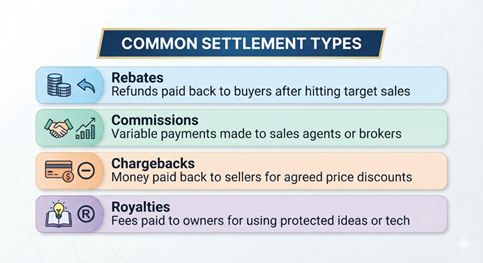
    Two trading partners calculate a business settlement as the final payment based on their agreed contract. These agreements are rarely simple flat discounts. Instead, they depend on moving sales targets, volume tiers, and special time windows.

    b9c63269-60c5-4cbc-a6d8-840138135dfd-image.png

    When teams try to track these items on paper or simple spreadsheets, small mistakes add up fast. Data gets lost across different systems, and human error leads to missed money or late payouts. Automated settlement management provides one central home to track, calculate, and complete every agreement without the headache.

    How Does SAP Settlement Management Automate Complex Settlements?

    Settlement automation turns complex contract text into dynamic smart rules. These rules run in the background whenever a team creates a new invoice or sales order.

    Manual Settlement Process - Automated Settlement Management

    Data Spread Across Files - Data Stored in One Central Place for All Contracts

    Here is an overview of how the primary components of the system interact to maintain the flow of payments:

    Condition Contracts
    In contrast to the legacy email chains or files, all conditions are stored in one integrated file, including valid dates, product lines, partner groups, and payment levels.

    Accrual Calculation
    As each day's sales occur, the software computes the expected payouts almost instantly. This way, balances in balance sheet accounts get updated automatically, and finance departments get an instant insight into their financial status.

    Target Tracking
    The system monitors the total purchases and sales with respect to contract targets on a daily basis. Students learning SAP training in Mumbai devote time to comprehending the workings of this monitoring engine.

    Automated Payout
    When a partner hits an agreed goal, the system builds payout documents automatically. It eliminates the need for staff to manually review thousands of old receipts.

    Credit and Debit Notes
    The program creates correct credit or debit notes, sends them for approval by the manager and then automatically posts them directly to the accounting ledgers.

    How Does SAP Settlement Management Handle Complex Business Scenarios?

    It becomes very complex in real situations. It is hard to find any flat bonus arrangement in the international chain of supply due to the multi-stage nature of transactions, different prices, and involvement of various business parties.

    A settlement solution will be able to cope with any complex transaction structure without calculations:
    • Retrospective Rebates: Rates of bonus applied to each unit purchased after reaching a certain level of sales targets.
    • Multi-Tier Agreements: Programs offering increasing bonuses depending on increasing sales volumes.
    • Distributor Chargebacks: Compensating the distributor for offering discounts to special customers such as schools and hospitals.
    • Multi-Party Settlements: Distributing payments/charges among three or more business partners involved in a particular transaction.
    Students enrolled in Sap Classes in Kolkata learn about using multi-party features in dealing with complicated chargebacks without generating double entries.

    Real-World Electronics Rebate Example

    Imagine a big electronics manufacturer that sells TVs to national retail stores. To boost mid-year sales, the manufacturer offers a Rs 50,000 rebate bonus if a store buys 10,000 TVs within six months.

    1. Setting the Rules: The team defines the terms of the agreement through a conditional contract with a particular starting date and ending date.

    2. Daily Tracking: The shop buys a television every week. Every time a television is bought, Rs. 5 is accrued in temporary accounts.

    3. Hitting the Target: In month five, the store orders TV number 10,000.

    4. Instant Action: The software recognises that the goal has been achieved and immediately prepares a Rs. 50,000 credit memo.

    5. Clean Books: The system disburses the money and resets all the temp accounts.

    It was not necessary to go through piles of paper invoices, make calculations using a formula in an Excel spreadsheet, or negotiate the missing information. Everything went perfectly fine.

    What Are the Benefits of SAP Settlement Management?

    There are many benefits for growing finance departments and their business partners when switching to automation in the process of settlements.
    • Reduced Financial Leakage: This is the elimination of overpayments of any claims and missing vendor rebates.
    • Clear Auditability: Every credit note is linked directly to the sales invoice and contract.
    • Faster Settlements: Review periods for the monthly payment can be shortened from weeks to minutes.
    • Better Partner Relationships: Quick and accurate payments ensure there will not be disputes on the terms of the deal.
    • Profitability Visibility: The finance management gets access to the actual figures of profit immediately.

    Conclusion
    Automation of settlement processes helps make complicated business transactions much easier and cleaner. Combining all the terms of the contract and automating routine calculations ensures that organisations do not lose their profit margin and save a lot of time. This is a good way for students who study financial technologies to learn about enterprise operations.

  • Login

  • Don't have an account? Register

  • Login or register to search.
  • First post
    Last post
0
  • Categories
  • Recent
  • Tags
  • Popular
  • Users
  • Groups