
How Does SAP Settlement Management Automate Complex Business Settlements?
-
Enterprise organisations deal with thousands of business deals on a daily basis. Managing all the financial transactions involves rebate, commission and chargeback calculations, which cannot be delayed. Manual calculations in traditional spreadsheets lead to many accounting errors, loss of money, and delayed payments. Digital technologies help to eliminate all financial difficulties by fully automating complex calculations.
In Sap Classes Pune, students often discuss the role of automation for managing commercial transactions and high volumes of work. By automating the whole process, companies will be able to concentrate on their further development, rather than on solving problems connected with manual payment management. In this article, we will consider in detail how the technology works and what its practical application is.
What Is SAP Settlement Management?
Two trading partners calculate a business settlement as the final payment based on their agreed contract. These agreements are rarely simple flat discounts. Instead, they depend on moving sales targets, volume tiers, and special time windows.
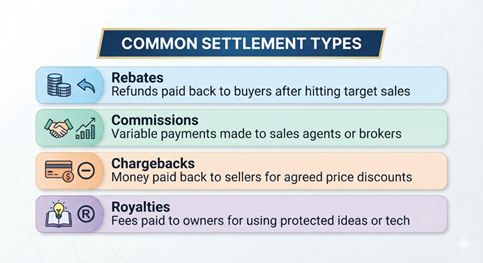
When teams try to track these items on paper or simple spreadsheets, small mistakes add up fast. Data gets lost across different systems, and human error leads to missed money or late payouts. Automated settlement management provides one central home to track, calculate, and complete every agreement without the headache.
How Does SAP Settlement Management Automate Complex Settlements?
Settlement automation turns complex contract text into dynamic smart rules. These rules run in the background whenever a team creates a new invoice or sales order.
Manual Settlement Process - Automated Settlement Management
Data Spread Across Files - Data Stored in One Central Place for All Contracts
Here is an overview of how the primary components of the system interact to maintain the flow of payments:
Condition Contracts
In contrast to the legacy email chains or files, all conditions are stored in one integrated file, including valid dates, product lines, partner groups, and payment levels.Accrual Calculation
As each day's sales occur, the software computes the expected payouts almost instantly. This way, balances in balance sheet accounts get updated automatically, and finance departments get an instant insight into their financial status.Target Tracking
The system monitors the total purchases and sales with respect to contract targets on a daily basis. Students learning SAP training in Mumbai devote time to comprehending the workings of this monitoring engine.Automated Payout
When a partner hits an agreed goal, the system builds payout documents automatically. It eliminates the need for staff to manually review thousands of old receipts.Credit and Debit Notes
The program creates correct credit or debit notes, sends them for approval by the manager and then automatically posts them directly to the accounting ledgers.How Does SAP Settlement Management Handle Complex Business Scenarios?
It becomes very complex in real situations. It is hard to find any flat bonus arrangement in the international chain of supply due to the multi-stage nature of transactions, different prices, and involvement of various business parties.
A settlement solution will be able to cope with any complex transaction structure without calculations:
• Retrospective Rebates: Rates of bonus applied to each unit purchased after reaching a certain level of sales targets.
• Multi-Tier Agreements: Programs offering increasing bonuses depending on increasing sales volumes.
• Distributor Chargebacks: Compensating the distributor for offering discounts to special customers such as schools and hospitals.
• Multi-Party Settlements: Distributing payments/charges among three or more business partners involved in a particular transaction.
Students enrolled in Sap Classes in Kolkata learn about using multi-party features in dealing with complicated chargebacks without generating double entries.Real-World Electronics Rebate Example
Imagine a big electronics manufacturer that sells TVs to national retail stores. To boost mid-year sales, the manufacturer offers a Rs 50,000 rebate bonus if a store buys 10,000 TVs within six months.
-
Setting the Rules: The team defines the terms of the agreement through a conditional contract with a particular starting date and ending date.
-
Daily Tracking: The shop buys a television every week. Every time a television is bought, Rs. 5 is accrued in temporary accounts.
-
Hitting the Target: In month five, the store orders TV number 10,000.
-
Instant Action: The software recognises that the goal has been achieved and immediately prepares a Rs. 50,000 credit memo.
-
Clean Books: The system disburses the money and resets all the temp accounts.
It was not necessary to go through piles of paper invoices, make calculations using a formula in an Excel spreadsheet, or negotiate the missing information. Everything went perfectly fine.
What Are the Benefits of SAP Settlement Management?
There are many benefits for growing finance departments and their business partners when switching to automation in the process of settlements.
• Reduced Financial Leakage: This is the elimination of overpayments of any claims and missing vendor rebates.
• Clear Auditability: Every credit note is linked directly to the sales invoice and contract.
• Faster Settlements: Review periods for the monthly payment can be shortened from weeks to minutes.
• Better Partner Relationships: Quick and accurate payments ensure there will not be disputes on the terms of the deal.
• Profitability Visibility: The finance management gets access to the actual figures of profit immediately.Conclusion
Automation of settlement processes helps make complicated business transactions much easier and cleaner. Combining all the terms of the contract and automating routine calculations ensures that organisations do not lose their profit margin and save a lot of time. This is a good way for students who study financial technologies to learn about enterprise operations. -