Skip to content
  • Categories
  • Recent
  • Tags
  • Popular
  • Users
  • Groups
Skins
  • Light
  • Dark

Collapse
Brand Logo

Forum

T

topitcourses

@topitcourses
About
Posts
5
Topics
5
Groups
0
Followers
0
Following
0

Posts

Recent Best Controversial

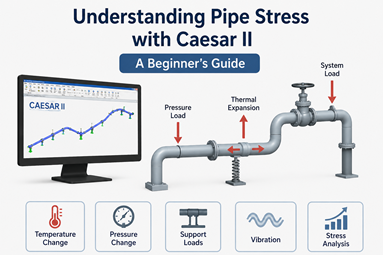
  • Understanding Pipe Stress with Caesar II: A Beginner’s Guide
    T topitcourses

    Piping systems are used in almost every industry. They carry water, steam, chemicals, oil, and gas from one place to another. These pipes work under pressure and high temperature for long hours. Because of this, pipes do not stay completely still during operation. Learning this through Caesar II Training helps beginners understand how industrial piping actually works inside a plant.

    33aa5611-70e7-41dd-b91d-c1fa0f7585d2-image.png

    Pipe stress is not only about checking if the pipe is strong. It is mainly about checking how the whole pipeline behaves during operation. When temperature increases, the pipe expands. When pressure changes, extra load comes on the pipe. If this movement is not handled properly, the system can face leakage, bending, support damage, or vibration problems. Caesar II software helps engineers find these issues before the piping system is installed.

    What is Pipe Stress Analysis?

    Pipe stress analysis means checking the forces and movement inside a piping system. Engineers create a model of the pipeline in Caesar II software and apply operating conditions like temperature, pressure, and weight.
    The software checks things like:
    ● Pipe weight
    ● Pressure load
    ● Thermal expansion
    ● Support load
    ● Pipe movement
    ● Equipment load
    These checks are important because industrial piping systems work continuously. Even a small mistake in design can create problems later during operation.
    Most beginners who start learning through Caesar ii Certification programs first study piping codes because all stress calculations follow standard industrial rules.

    Why Caesar II is Used So Much?

    Caesar II is one of the most commonly used pipe stress software tools in industries. It is used in refineries, chemical plants, power plants, and offshore projects.
    The software helps engineers:
    ● Build pipe models
    ● Add supports
    ● Apply pressure and temperature
    ● Check stress values
    ● Study pipe movement
    ● Calculate support loads
    Industries use Caesar II because it gives detailed results and helps reduce design mistakes before construction starts.
    Many engineers also learn PDMS Software Training because pipe routing and plant layout directly affect pipe stress results.

    Thermal Expansion in Pipes

    Thermal expansion is one of the biggest reasons stress develops inside piping systems. When a pipe becomes hot, its length increases. Long pipelines expand even more.
    If the pipe does not get enough space to move, stress starts building inside the system.
    To reduce this stress, engineers use:
    ● Pipe bends
    ● Expansion loops
    ● Flexible routing
    ● Spring supports
    Caesar II calculates how much the pipe moves during operation and checks whether the stress is within safe limits.
    People learning E3D Online Training also understand how proper pipe routing helps reduce thermal stress naturally.

    Importance of Pipe Supports

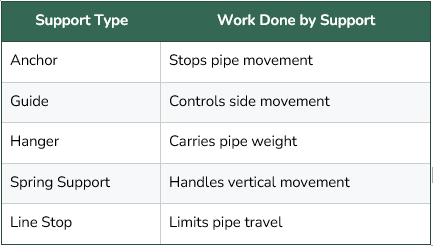
    Pipe supports are very important in stress analysis. Supports hold the pipe and control its movement. Wrong support placement can increase stress and vibration problems.
    Different support types are used for different conditions.
    acc0f9e6-1cac-492b-a7cf-bc3e7851c963-image.png
    During Caesar II Training, students learn that even a small support change can affect the complete stress result of the piping system.

    Load Cases in Caesar II

    Pipe stress analysis works with different load conditions called load cases. Every load case checks a separate operating condition.
    Common load cases include:
    ● Weight load
    ● Pressure load
    ● Thermal load
    ● Sustained load
    ● Occasional load
    Sustained load checks pressure and weight conditions. Thermal load checks expansion stress during operation. Occasional load checks conditions like wind or earthquake force.
    Students preparing for Caesar ii Certification spend a lot of time understanding these load cases because correct setup is very important for proper analysis.

    Pipe Routing and Stress

    Pipe routing has a direct effect on stress values. Engineers add bends and offsets to improve flexibility. This helps the pipe absorb expansion in a better way.
    Good routing also helps in:
    ● Easy maintenance
    ● Better support access
    ● Proper equipment connection
    ● Safe pipe spacing
    This is why many engineers prefer learning PDMS Software Training together with stress analysis because routing and stress work closely together.

    Vibration Problems in Piping

    Some pipelines face vibration during operation. This mostly happens near pumps, turbines, and compressors. Continuous vibration can damage supports and pipe joints slowly over time.
    Caesar II can perform dynamic analysis to study vibration behavior inside the piping system.
    This analysis becomes important in:
    ● Steam pipelines
    ● Compressor lines
    ● Gas piping systems
    ● Offshore piping systems
    Engineers learning E3D Online Training also study how routing changes can help reduce vibration problems in piping systems.

    Conclusion

    Pipe stress analysis forms an integral part of designing industrial piping systems. It assists engineers in knowing the performance characteristics of pipelines in the working environment. Pipe stress analysis is made easy using software such as Caesar II, which enables the analysis of thermal expansion, load bearing capacity, vibrations, and pipe movement. This will assist industries to enhance safety and avoid future failures. Beginners who undergo proper pipe stress learn more on piping system designs.


  • Guidewire Rules Engine: How Business Rules Actually Execute at Runtime
    T topitcourses

    245d5a94-868f-46c2-98f0-437c9c5fcdc4-Guidwire.jpg

    Insurance systems run many tasks at the same time. Claims get updated. Policies get changed. Payments get checked. Customer details get verified. All these activities depend on rules running inside the backend. In Guidewire, this work is handled by the Rules Engine. It controls how the system reacts during runtime. It checks conditions, validates data, creates activities, and controls transaction flow. This is why many people joining Guidewire Training now focus more on runtime behavior instead of only learning screens and navigation.
    Most people think rules run one after another in a simple flow. But that is not how Guidewire actually works. The runtime engine checks entity changes, transaction states, and rule categories before starting execution. Every rule runs based on a trigger inside the application.

    How Rules Start Inside the System?

    Whenever a user updates a claim or changes policy data, the system sends an event to the runtime engine. The engine first checks which object has changed. After that, it loads only the required rules.
    This process is important because insurance applications may contain thousands of rules. If all rules load together, the system becomes slow.
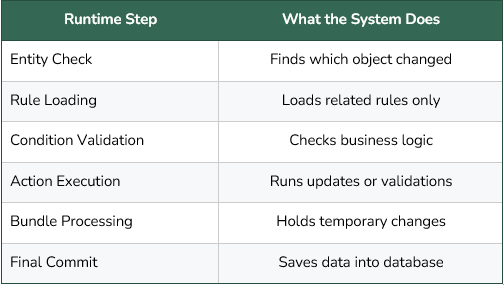
    The runtime engine mainly follows this flow:
    f5aa10c8-e4bb-4d83-b26c-736fa6f657bd-image.png
    This runtime flow is one of the biggest topics discussed during advanced Guidewire Certification learning because most real production problems happen during execution.

    Why Does Rule Order Matter?

    Rule order is very important in Guidewire. Two correct rules can still create wrong output if they run in the wrong sequence.
    For example, one rule may update reserve amounts while another rule checks approval conditions. If the approval rule runs first, the transaction may fail because updated reserve data is not available yet.
    The engine checks many things before executing rules:
    ● Transaction stage
    ● Rule priority
    ● Object condition
    ● Runtime trigger
    ● Data dependency
    Because of this, debugging becomes difficult in large projects.
    Teams usually check logs to understand which rule started first and where the transaction failed. This is why many professionals take a Guidewire Testing Course to understand runtime failures properly.

    Understanding Bundles

    Guidewire uses bundles during transactions. A bundle is a temporary storage area inside memory where changes stay before saving into the database.
    Rules mostly work on bundle data during runtime.
    This creates some important behavior inside the system:
    ● Rules can read temporary values
    ● Multiple updates can happen together
    ● Rollback can remove changes
    ● Runtime values may differ from database values
    This is one reason why production debugging becomes confusing sometimes.
    Many learners studying through a Guidewire Functional Course get confused when logs show one value while the database shows another value. The reason is that runtime changes still exist inside the bundle and are not committed yet.

    Runtime Conditions Affect Performance

    Conditions inside rules affect application speed directly. If conditions are badly written, runtime performance drops.
    The engine checks many objects during execution. Extra loops and repeated checks increase processing time.
    Some common problems are:
    ● Long loops
    ● Extra database calls
    ● Repeated object loading
    ● Deep nested conditions
    ● Heavy Gosu logic
    Even one bad rule can slow down the whole transaction.
    Because of this, performance tuning is now an important part of modern Guidewire Training programs. Companies want developers who can write cleaner runtime logic with less server load.

    Different Rules Run at Different Stages

    Guidewire has different rule categories. All rules do not run together.
    Some common rule types are:
    ● Validation rules
    ● Assignment rules
    ● Activity rules
    ● Escalation rules
    ● Pre-update rules
    ● Post-update rules
    Validation rules run before saving data. Pre-update rules modify data before commit. Post-update rules run after the database save process finishes.
    This changes how entities behave during runtime.
    A field may allow changes during pre-update execution but may become locked later during post-update processing.
    This area is important during Guidewire Certification preparation because runtime stages affect business transactions directly.

    Gosu Logic During Runtime

    Guidewire rules use Gosu internally. Gosu handles calculations, validations, loops, and actions during execution.
    Bad Gosu code creates runtime issues very quickly.
    Some common mistakes are:
    ● Heavy loops
    ● Large database queries
    ● Extra calculations
    ● Repeated refresh calls
    ● Unnecessary entity traversal
    These problems increase memory usage and server processing time.
    Many enterprise teams now include runtime optimization practice in their Guidewire Testing Course because performance issues are becoming common in large insurance systems.

    Batch Jobs Work Differently

    Guidewire also runs batch jobs for bulk processing. Batch execution behaves differently from normal user transactions.
    During batch processing:
    ● Large datasets run together
    ● Multiple threads execute simultaneously
    ● Memory usage increases
    ● Cache usage becomes stronger
    ● Commit timing changes
    This is why some rules work properly during manual testing but fail during nightly batch jobs.
    Many advanced Guidewire Functional Course sessions now explain batch runtime separately because insurance companies depend heavily on automated backend processing.

    Logs Help Find Real Problems

    Runtime logs are very important in Guidewire projects. Most runtime issues cannot be solved only by reading rule code.
    Logs help teams understand:
    ● Which rule started first
    ● Which condition failed
    ● Which entity caused issues
    ● Which transaction rolled back
    ● Where performance became slow
    Without logs, debugging becomes very difficult in enterprise systems.
    This is another reason why advanced Guidewire Training now includes runtime tracing and log monitoring.

    Conclusion

    The Guidewire Rules Engine controls how insurance applications behave during runtime. It handles validations, calculations, approvals, activities, and transaction flow in the background. The engine does not simply run conditions one by one. It works through bundles, runtime stages, entity updates, and transaction handling. Many production problems happen because teams understand business logic but do not fully understand runtime execution flow.


  • Guidewire for Commercial Lines Underwriting: Modern Risk Assessment
    T topitcourses

    If you are looking to run a successful insurance company, you need to keep in mind the risk factors. Well, in the world of business insurance, which is known as "Commercial Lines,” it is getting difficult. Unlike car or home insurance for a single person, a business might have many buildings, hundreds of employees, and expensive equipment.

    For a long time, insurance companies were used to being slow and traditional, with paper systems to manage them. Today, they are using the tool called Guidewire PolicyCenter. To understand how this works, one can apply for Guidewire Training. This software acts like a high-tech brain for insurance companies, helping them decide which businesses to cover and how much to charge. So let’s begin discussing this in detail:

    The Big Challenge in Business Insurance

    Underwriting is the process of checking a business to see how "risky" it is. A single business might need coverage for its office, its delivery trucks, and its workers. Checking all of this by hand causes problems. Taking the Guidewire Testing Training is a great solution for the same that lets the developers face these challenges effectively.

    The Problem of Slow Speed and Pricing

    In the modern world, speed is everything. When a business owner looks for insurance, they want an answer immediately. However, without a tool like Guidewire, the process of giving a price is

    Manual Data Entry: Without automation, workers need to type everything from the paper forms. Well, this can lead to data fatigue, and it results in mistakes made by tired employees. Also, it can take a long time to solve the same.

    The Waiting: In many traditional systems, files get passed from one person to another through mail or physical folders. If one human is on vacation or leave, then the entire quote will stop.

    Broker Frustration: Insurance agents and brokers work with many companies. If one company takes ten days to give a price and another takes ten minutes, the broker will always prefer the faster one. Slow speed literally causes companies to lose millions in potential business.

    The Lack of Consistency in Human Decisions

    One of the most dangerous things for an insurance company is "inconsistency." When people rely on their own feelings rather than a unified digital system, the company’s rules start to blur.

    The "Experience Gap": Senior workers are experienced, and they have knowledge that is locked in their minds. But what happens after retirement is the knowledge disappears. Young workers might not experience it, and they can also take decisions that are risky.

    Human Drift: Over a long week, a worker's mood can change. They might be stricter on a Monday morning than they are on a Friday afternoon. This "human drift" makes it impossible for a company to stay disciplined in how it handles risk.

    The Difficulty of Tracking Financial Health

    If you cannot see your data clearly, you cannot run a business. When a company uses fragmented or manual systems, it is like trying to drive a car with a painted-over windshield.

    Data Silos: Information is often trapped in different "silos." The department that handles truck insurance might not talk to the department that handles office insurance. This makes it impossible to see the total risk a single client poses to the company.

    How Guidewire Can Help

    Guidewire is highly adopted by the commercial line across the world. This is why applying for the course and getting Guidewire Certification can help you get the job opportunities locally and abroad as well.

    1. Managing New Requests

    When any of the insurance agents send a new business request to the company, Guidewire can capture all of the data. It includes business activities and location automatically. After that, it may send this request to the right expert. This can help prevent emails from getting lost and make sure that customers got help first.

    2. Using Real-Time Information

    Guidewire doesn't just rely on what the business tells them. It connects to the internet to pull in extra data. For example, it can instantly check the following:

    If the business is in a flood zone.
    The business's credit score.
    How many accidents does that industry usually have?
    This helps the insurance company make a faster, smarter choice.

    3. Rules and Automatic Pricing

    Guidewire has a "rules engine." The company’s best experts program their knowledge into the software. For simple businesses, the computer can give a price in minutes. If a business is very dangerous or unusual, the computer flags it for a human expert to double-check. This keeps the rules the same for everyone.

    4. Handling "All-in-One" Packages

    Most businesses need several types of insurance at once. Guidewire allows an underwriter to see every policy a business has in one single view. They don't have to jump between different computer programs to see the whole picture.

    5. AI Assistant

    In 2026, Guidewire uses "Agentic AI." This is like a smart assistant that watches the work. It flags mistakes, suggests better coverage for a specific industry, and makes sure the data being used is up to date. This prevents human errors during busy seasons.

    6. Managing Renewals

    Every year, insurance policies must be renewed. Guidewire looks at the whole year’s data and suggests whether the price should stay the same or change. It allows a manager to look at thousands of customers at once to see how the business is performing.

    Conclusion

    Guidewire can be considered more than just a computer program. Well, it is the future of how businesses stay protected. This can help the insurance companies to work faster, make fewer mistakes, and stay profitable. For anyone looking for a stable and well-paying career in technology, becoming a Guidewire expert is one of the best choices you can make today.


  • What Is Odoo ERP Software and Why Should You Choose It?
    T topitcourses

    Introduction

    Contemporary enterprises have transformed into the digital landscape. For the smooth running of the business operations, we need scalable and affordable solutions. The Odoo ERP is a powerful platform for managing all the activities inside an organization. This effective software system applies to all medium-sized enterprises and startups. The Odoo Training programs are designed for experienced employees to know about the advantages of the Odoo ERP solution.

    An In-Depth Look at Odoo ERP Software

    Odoo is an integral part of the enterprise resource planning system. It is an open-source platform. Odoo ERP merges numerous business applications into one system. It manages the core procedures of business, such as:
    • Accounting and Finance
    • Sales and CRM
    • Inventory and Supply Chain
    • Human Resources
    • Manufacturing
    • E-commerce and Website Management
    The organized structure of Odoo ensures the scalability of applications as the business expands.

    Chief Characteristics of Odoo

    The main features of the Odoo ERP system are the following:

    1. Odoo offers 30+ key modules and thousands of external apps to businesses to grow according to their requirements without disrupting workflow.
    2. An Easy-to-use interface aids professionals in adapting to it easily.
    3. Customization of new modules, workflows, and the system to meet specific goals of the business is another best attribute of Odoo.
    4. Blending of all modules ensures effortless data transfer across the departments.
    5. The Odoo ERP system is good for small-sized companies for its low-cost settings and maintenance.
      These characteristics are covered in the Odoo Training course for the learners.

    Choosing Odoo ERP Over Traditional ERP Systems

    Modern businesses are not comfortable working with the old resource planning platforms. These tools lack some of the great aspects that are required to operate the current complex firms.
    i) Odoo does not require data storage facilities and integrates everything in a single platform. It helps the business to increase its productivity.
    ii) The flexibility mode of Odoo aids in the modification of procedures without the intervention of the expensive suppliers.
    iii) Large community support of developers and partners ensures periodic improvements and upgrades.
    iv) The Odoo system is much easier to learn and understand than the conventional ERP platforms. It has built-in applications and a modular design.
    v) Selecting an Odoo Certification course provides practical experience to the trainees. They can apply the hands-on training in real workplaces. The certification programs develop special technical skills.
    vi) Worldwide implementation of Odoo increased the demand for qualified Odoo experts. Recruiters are looking for those candidates who have had Odoo training to hire them for these roles:
    • Odoo Developer
    • Functional Consultant
    • ERP Analyst
    • Business Process Consultant
    Thus, Odoo has lots of benefits for both professionals and organizations. On the one hand, it helps Odoo learners to have solid knowledge to stand out in this competitive job market. On the other hand, Odoo ERP resolves the operational efficiency issue of every size of enterprise.

    Conclusion

    Simplifying the complex processes of modern businesses requires flexible software. The Odoo ERP platform has a modular architecture and simple-to-use features. So it is the best solution to handle the organizational tasks. Starting from novices to expert professionals, going for the Odoo certification to make a strong career in ERP management systems.


  • Cloud computing: Driving the Digital Age with Smart and Scalable Technology
    T topitcourses

    The world today is highly technologically advanced, and businesses and individuals are extensively dependent on digital services to store, communicate, and carry out business operations. It may be costly and complicated to handle physical servers and infrastructure. It is here that cloud computing has revolutionized the IT scene by providing on-demand access to computing resources on-site via the internet.

    What is Cloud Computing?

    Cloud computing is the technology that provides computing services, including servers, databases, storage, networking, and software on the internet. Users are able to access such services when and where they require them instead of owning and maintaining physical infrastructure. This causes cloud computing to be an easy and effective way out to people and firms. To further know about it, one can visit Cloud Computing Training. Using cloud computing, users are able to:

    • Store and access data remotely
    • Launch applications without installation.
    • Demand-based scale resources.
    • Collaborate in real time
    • Reduce infrastructure costs

    Cloud Computing Has Various Types

    There are various types of cloud computing depending on the deployment models. These models specify the use and delivery of cloud services. Each of the types has its own advantages with regard to the needs of the organization. The primary ones are:

    • Public Cloud: Services are offered through the internet and are shared with more than one user.
    • Private Cloud: Single-organizational cloud.
    • Hybrid Cloud: A public and private cloud combination.

    Cloud Service Models

    Cloud computing provides various models of services that determine the responsibility and control of the users. These models enable the users to select the services according to their needs. Some of the main service models are the following:

    • Infrastructure as a Service (IaaS): Offers virtualized computing options.
    • Platform as a Service (PaaS): Provides an application development platform.
    • Software as a Service (SaaS): Provides services based on software applications via the internet.

    Advantages of Cloud Computing

    Cloud computing is adopted by organizations due to the many benefits associated with it. It assists businesses to be more efficient, cost-effective, and performance-based. These advantages make cloud computing one of the preferred options for contemporary businesses. Key benefits include the following:

    • Scalability: Adjustment of resources with demand easily.
    • Economic Saving: Only pay as you consume.
    • Accessibility: Anywhere access to data.
    • Security: Advanced security measures and compliance
    • Availability: High disaster recovery and high availability.

    Applications of Cloud Computing

    Cloud computing is common to industries with a wide range of applications. It is flexible, and so it can be applied to a variety of business needs. These applications highlight the importance of cloud computing in everyday operations. Common applications include:

    • Storage and backup of data.
    • Hosting of web and mobile applications.
    • Big data analytics
    • Machine learning and artificial intelligence.
    • Remote work and collaboration tools.

    Difficulties in Cloud Computing

    Though cloud computing has some points, it also has some problems. To get the most out of cloud computing, companies need to solve these problems. Good planning and management can help fix these problems. Some common problems are:

    • Data privacy and data security issues.
    • Service downtime and downtime.
    • Cost management
    • Vendor lock-in
    • Compliance with regulations

    The Future of Cloud Computing

    Cloud computing has a future as technology gets better. Cloud computing is getting more powerful and smart with the growth of intelligence, the Internet of Things, and big data. These trends show that cloud computing will keep changing the future of technology. Several colleges also offer Cloud Computing Course in Delhi. By joining them, you can begin a career in this field. Emerging trends include:

    • Expansion of multi-cloud solutions.
    • More use of serverless computing.
    • Integration with artificial intelligence
    • Growth of edge computing.

    Conclusion

    Cloud computing is changing how businesses and people use technology. Cloud computing can offer flexible and dependable solutions, which makes it a must-have in the digital world. Cloud computing is really helpful for businesses. There are numerous institutes offering the Cloud Computing Certification Course and by joining them, you are bound to have a high-paying career in this field. With the implementation of cloud computing, organizations are able to become more efficient, more innovative, and competitive in a fast-changing environment. With the evolution of technology, cloud computing will continue to be a central force in the digital transformation.

  • Login

  • Don't have an account? Register

  • Login or register to search.
  • First post
    Last post
0
  • Categories
  • Recent
  • Tags
  • Popular
  • Users
  • Groups