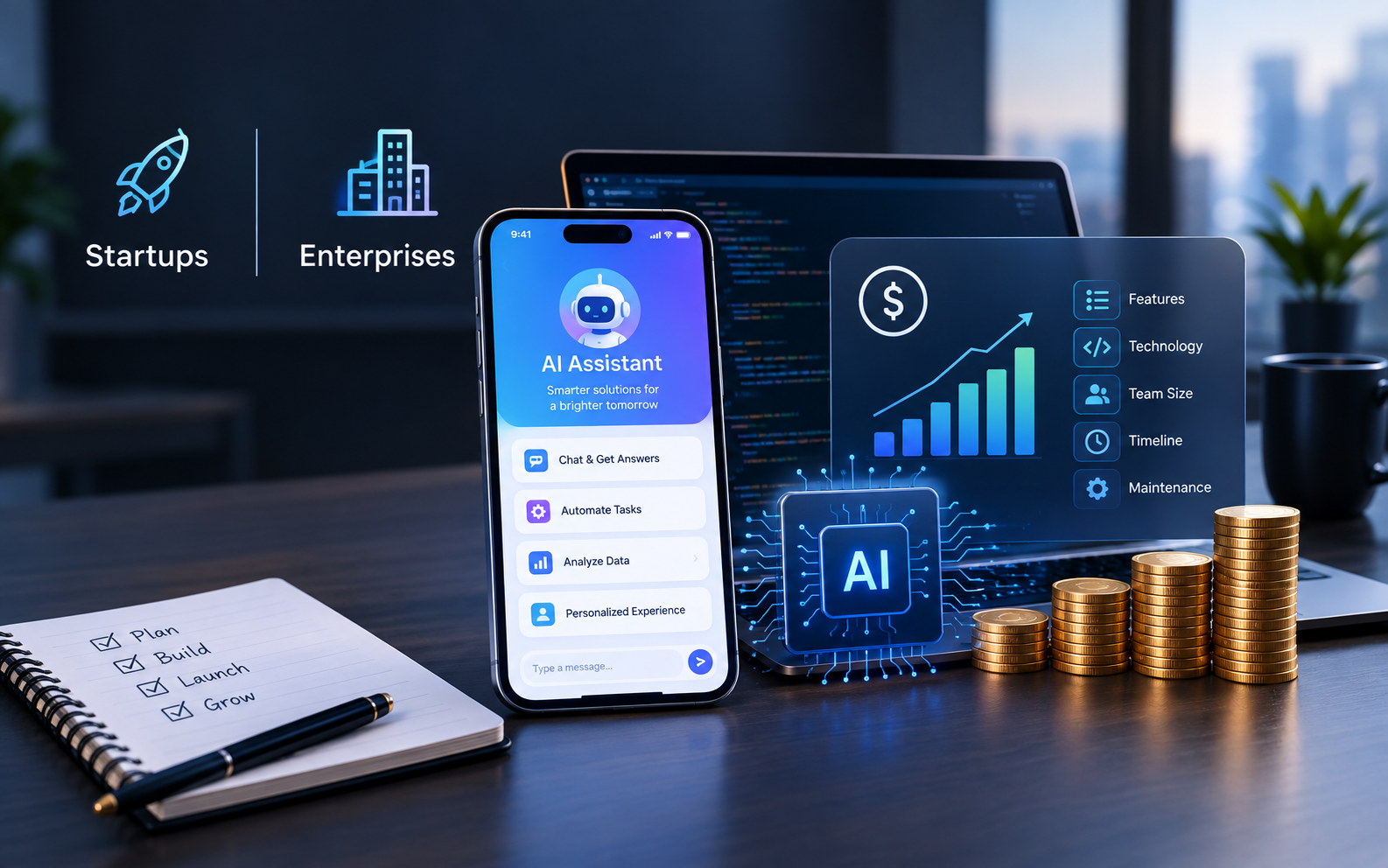
Enterprise AI projects are fundamentally different from building a simple chatbot or proof-of-concept. They often involve complex technology ecosystems, sensitive business data, regulatory requirements, legacy applications, multiple stakeholders, and expectations around scalability and ROI. Choosing the right AI development partner can therefore have a direct impact on whether an AI initiative moves successfully from experimentation to production.
Organizations evaluating AI development services should look beyond technical expertise. The right partner should understand enterprise architecture, business objectives, data security, AI governance, integration requirements, and long-term product strategy.
Here are the key factors enterprises should consider when evaluating an AI development partner.
1. Understand Their Enterprise AI Experience
The first step is to determine whether the provider has experience delivering AI solutions for organizations with complex requirements.
Ask potential partners about:
- Enterprise AI projects they have delivered
- Industries they have worked with
- AI models and technologies they have implemented
- Production deployments rather than only prototypes
- Challenges they encountered and how they solved them
- Scalability of their previous AI solutions
A company may have strong machine learning capabilities but limited experience with enterprise environments. Look for evidence that the partner can manage large-scale deployments, multiple integrations, security requirements, and ongoing optimization.
2. Evaluate Their AI Development Capabilities
A reliable AI development partner should have expertise across multiple layers of the AI technology stack rather than relying on a single technology.
Depending on the project, relevant capabilities may include:
- Generative AI
- Large language models (LLMs)
- Machine learning
- Natural language processing
- Computer vision
- AI agents
- Retrieval-augmented generation (RAG)
- Predictive analytics
- Recommendation systems
- AI-powered automation
- Model fine-tuning
- AI governance and monitoring
The objective is not to find a provider that uses the most technologies. Instead, enterprises should determine whether the partner can select the right technology based on the business problem.
3. Check Their AI Integration Expertise
Enterprise AI rarely operates as an isolated application. It usually needs to communicate with existing CRM, ERP, databases, cloud platforms, APIs, data warehouses, and internal applications.
This makes integration capability one of the most important evaluation criteria.
A capable AI integration provider should be able to connect AI solutions with existing enterprise infrastructure while maintaining security and reliability.
Ask whether the provider has experience integrating AI with platforms such as:
- Salesforce
- Microsoft Dynamics
- SAP
- Oracle
- AWS
- Microsoft Azure
- Google Cloud
- Enterprise databases
- Internal APIs
- Data warehouses
- Business intelligence platforms
The partner should also explain how it plans to handle authentication, data synchronization, API management, error handling, and system monitoring.
4. Assess Data Security and Privacy Practices
Enterprise AI projects frequently involve confidential customer, financial, operational, or employee data. Security should therefore be evaluated before discussing features or development timelines.
Ask potential partners about:
- Data encryption
- Access controls
- Identity and authentication
- Data retention policies
- Secure API architecture
- Cloud security
- Data isolation
- Audit logging
- Privacy controls
- Compliance requirements
- Third-party AI model data usage
Enterprises should also understand whether data is sent to external model providers and how that data is handled.
A strong AI partner should be able to clearly explain its security architecture instead of simply stating that the solution is "secure."
5. Look for a Strong AI Governance Approach
As AI becomes embedded in business processes, governance becomes increasingly important.
Your development partner should help establish policies around:
- AI model selection
- Human oversight
- Responsible AI
- Bias detection
- Model monitoring
- Explainability
- Data governance
- Access permissions
- Prompt and output management
- Incident management
For highly regulated industries, governance should be considered from the beginning of the project rather than added after deployment.
6. Review Their Development and Delivery Process
A mature AI development partner should have a clearly defined process for moving an idea from discovery to production.
A typical enterprise AI project may include:
Discovery → Data Assessment → AI Strategy → Proof of Concept → Development → Integration → Testing → Deployment → Monitoring → Optimization
Ask how the company handles each stage.
You should also determine:
Who owns technical architecture?
How frequently will progress be demonstrated?
How are requirements documented?
How is testing performed?
How are production issues handled?
What happens after deployment?
A transparent process reduces uncertainty and helps enterprise stakeholders maintain visibility throughout development.
7. Examine Their Approach to Proof of Concept
A proof of concept can be useful for validating whether an AI solution can solve a specific business problem before significant investment.
However, an enterprise AI partner should not treat the POC as the final product.
Ask the provider:
What business hypothesis will the POC validate?
What data will be used?
What success metrics will be measured?
How will the POC transition into production?
What architecture changes will be required at scale?
The best partners design POCs with production scalability in mind.
8. Evaluate Model Selection and Vendor Strategy
Enterprises should be cautious of partners that automatically recommend one AI model or platform for every project.
Depending on the use case, an enterprise may need to compare different proprietary and open-source models based on:
- Accuracy
- Latency
- Cost
- Context window
- Security
- Data requirements
- Customization
- Infrastructure requirements
- Performance at scale
A good AI development partner should be able to explain why a particular model or architecture is appropriate rather than simply recommending the technology they already use.
9. Ask About Scalability
An AI application that works for 100 users may behave very differently when deployed to 100,000 employees or customers.
During evaluation, ask how the provider addresses:
- Increasing workloads
- Concurrent users
- Model inference costs
- Response latency
- Database scaling
- Cloud infrastructure
- Caching
- Failover
- Load balancing
- Monitoring
Scalability should be part of the initial architecture rather than an afterthought.
10. Analyze the Total Cost of Ownership
The development quote is only one component of enterprise AI costs.
Organizations should consider the complete cost structure, including:
- AI development
- Cloud infrastructure
- Model/API usage
- Data storage
- Integration
- Security
- Monitoring
- Maintenance
- Model optimization
- Human review
- Future feature development
A provider offering the lowest initial development cost may not necessarily deliver the lowest total cost over three or five years.
Ask potential partners to explain both initial investment and ongoing operational costs.
11. Validate Their Team and Technical Expertise
The company's website alone is not enough to evaluate its capabilities.
Ask who will actually work on your project and what their roles will be.
A strong enterprise AI team may include:
- AI/ML engineers
- Data engineers
- AI architects
- Backend developers
- Cloud engineers
- DevOps specialists
- Security professionals
- QA engineers
- Product managers
You should also determine whether senior technical professionals will remain involved after the initial discovery phase.
12. Review Case Studies and References
Case studies can provide valuable insight into how an AI development partner approaches real-world problems.
Don't only look at the technologies used. Examine:
- Business problem
- Solution architecture
- Implementation approach
- Integration complexity
- Deployment scale
- Business outcomes
- Long-term support
Whenever possible, ask for references from clients with similar technical or business requirements.
13. Measure Business ROI
Enterprise AI should ultimately deliver measurable business value.
Before selecting a partner, define KPIs such as:
- Reduction in operational costs
- Faster customer response
- Increased employee productivity
- Improved forecasting accuracy
- Reduced processing time
- Higher conversion rates
- Improved customer satisfaction
- Reduced manual workloads
The development partner should help translate AI capabilities into measurable business outcomes.
14. Assess Post-Deployment Support
AI systems require continuous monitoring and improvement. Models, data, business requirements, and user behavior can change over time.
Ask whether the partner provides:
- AI model monitoring
- Performance optimization
- Bug fixes
- Security updates
- Infrastructure management
- Model upgrades
- Analytics
- Technical support
- Continuous AI integration
A long-term support strategy can be just as important as the initial development process.
Questions to Ask Before Hiring an AI Development Partner
Before signing a contract, decision-makers should ask:
Have you delivered similar enterprise AI projects?
Can you integrate AI with our existing technology stack?
Which AI models would you recommend and why?
How will you protect our business data?
How will the solution scale after deployment?
What metrics will define project success?
How will you control AI infrastructure and model costs?
Who will be responsible for architecture and technical decisions?
What is included in post-launch support?
How will you continuously monitor and improve the AI solution?
The answers can reveal whether a potential partner is simply selling AI development or actually capable of becoming a long-term technology partner.
Final Thoughts
Selecting an AI development partner is a strategic decision for an enterprise. Technical skills matter, but they are only one part of the equation. Businesses should evaluate a provider's enterprise experience, AI capabilities, integration expertise, security practices, scalability, development methodology, team structure, cost model, and long-term support.
The ideal AI integration provider should be able to bridge the gap between AI technology and existing enterprise systems while keeping business objectives at the center of development.
By using a structured evaluation process rather than choosing a provider based on pricing or technology buzzwords, enterprises can build AI solutions that are secure, scalable, measurable, and capable of delivering sustainable business value.