
Customer support is moving from simple automation toward systems that can understand requests, access business information and take action. Customers expect fast answers, but support teams still need to manage complex cases, repetitive tickets, multiple channels and rising service expectations.
AI Agents for Customer Support are emerging as a practical way to address this gap. Instead of stopping after generating an answer, an AI agent can understand customer intent, retrieve relevant information, follow business rules, execute approved tasks and escalate cases when human expertise is needed.
The shift is already significant. Gartner reported in 2026 that 91% of surveyed customer service and support leaders faced executive pressure to implement AI. Their leading priorities included customer satisfaction, operational efficiency and successful self-service.
For businesses, the opportunity is not to automate every conversation. It is to identify where AI improves resolution, reduces repetitive work and gives human support teams more capacity for complex customer needs.
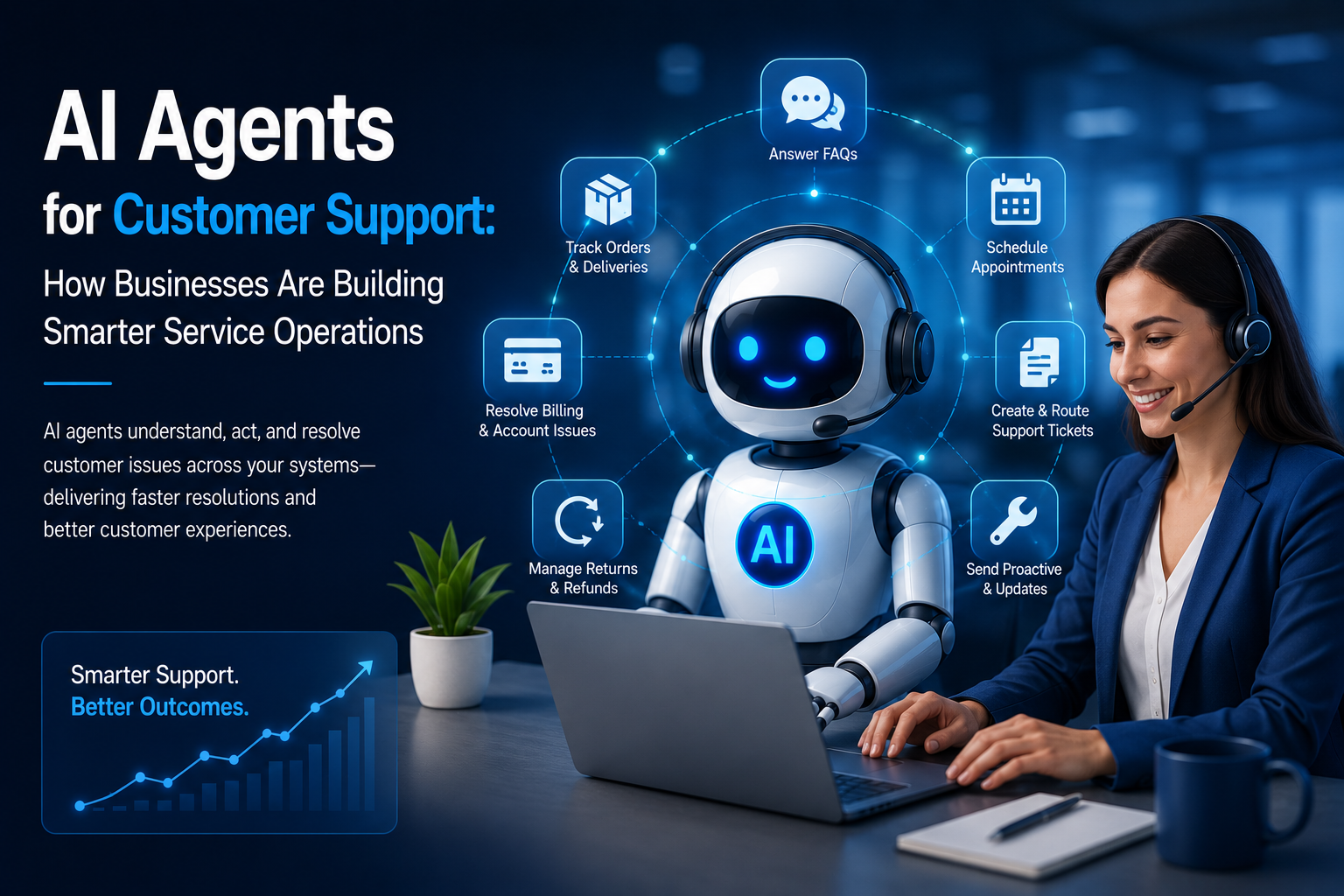
What Are AI Agents for Customer Support?
AI Agents for Customer Support are software systems designed to understand customer requests and work toward completing defined support outcomes.
A traditional chatbot might answer:
“What is your return policy?”
An AI agent can handle a more involved request:
“I received the wrong product. Check my order, tell me if I qualify for a replacement and help me start the process.”
The second interaction requires more than a knowledge-base answer. The system needs to understand intent, access customer context, retrieve order information, apply business rules and potentially initiate a workflow.
AI agents typically connect with systems such as:
- CRM platforms
- Help desk and ticketing systems
- Knowledge bases
- Customer databases
- Order management systems
- Billing platforms
- Scheduling applications
- Internal business systems
The agent becomes a service layer between the customer and these systems.
This creates an important distinction between generative AI and agentic AI. Generative AI produces content. An AI agent uses AI capabilities within a defined process to pursue an outcome.
For enterprise support, permissions and controls remain essential. The agent should know what information it can access, what actions it can perform and when it must involve a human.
AI Agents vs Traditional Customer Service Chatbots
Traditional chatbots remain useful for simple, predictable interactions. They can answer common questions, direct customers to resources and collect basic information.
The limitations appear when a customer request requires context or several actions.
Traditional chatbots are useful for simple, predictable customer interactions, while AI agents are designed to support more complex customer service workflows.
Traditional chatbots typically rely on predefined responses, keyword matching and fixed conversation flows. AI agents use natural-language understanding, maintain relevant context and connect with enterprise knowledge and business systems.
The key differences include:
-
Language understanding: Traditional chatbots rely on keyword and intent matching. AI agents understand natural-language requests.
-
Conversation context: Traditional chatbots have limited context. AI agents maintain relevant context throughout the interaction.
-
Knowledge: Traditional chatbots use predefined content. AI agents retrieve information from connected enterprise knowledge sources.
-
Personalization: Traditional chatbots provide basic personalization. AI agents use approved customer context.
-
CRM integration: Traditional chatbots often have limited integrations. AI agents support connectivity with business systems.
-
Workflow execution: Traditional chatbots follow fixed flows. AI agents support defined multi-step workflows.
-
Task completion: Traditional chatbots have limited action capabilities. AI agents support approved customer service actions.
-
Escalation: Traditional chatbots typically provide basic routing. AI agents support context-aware handoffs to human agents.
-
Conversation history: Traditional chatbots retain limited history. AI agents maintain persistent context where configured.
-
Analytics: Traditional chatbots focus on interaction metrics. AI agents provide conversation and outcome analytics.
A chatbot can reduce the number of questions reaching an employee. An AI agent has the potential to reduce the work required to resolve the underlying issue.
That makes agentic support especially relevant for businesses with complex customer journeys.
Why Businesses Are Investing in AI Agents for Customer Support
The business case starts with repetitive work.
Support teams handle recurring requests about orders, billing, account access, product information, appointments, returns and troubleshooting. These interactions are important, but many follow structured patterns.
AI agents can take responsibility for suitable workflows while human representatives focus on cases requiring judgment, empathy or specialized knowledge.
Current research shows how quickly the technology is moving into service operations. Salesforce reported in May 2026 that 66% of surveyed customer service professionals said their organizations used AI agents, up from 39% in 2025. The survey covered 3,075 service professionals across multiple regions, so the figure should not be treated as a U.S.-only adoption rate.
The same research found that 70% of organizations using AI agents reported measurable value within 60 days of deployment. Customer satisfaction ranked as the most improved KPI in the research, ahead of several operational measures.
The business implications include:
- Faster first responses
- More self-service
- Lower repetitive workload
- Better support scalability
- Faster information retrieval
- Improved agent productivity
- More consistent responses
- Better use of human support capacity
- Support availability outside normal operating hours
However, these benefits depend on selecting suitable workflows and integrating AI with reliable business information.
High-Value Use Cases for AI Agents
The strongest implementations focus on customer problems with clear processes and measurable outcomes.
FAQ resolution
AI agents can answer questions about products, services, policies, pricing, availability and account processes using approved knowledge.
The business value is reduced repetitive contact and faster customer access to information.
Order and delivery support
An agent connected to order and shipping systems can provide delivery status, shipment information and approved order updates.
Instead of waiting for a representative to look up an order, the customer receives information during the conversation.
Billing and account support
AI can handle routine billing questions, explain account information and guide customers through approved processes.
Sensitive actions should require authentication and appropriate permissions.
Returns and refunds
An AI agent can determine whether a request follows an established policy, collect required information and guide the customer through the next step.
Exceptions can be escalated to a human representative.
Ticket creation and routing
Customers can explain their issue naturally instead of navigating a long support form.
The AI can identify the issue, gather required details, classify the case and route it to the appropriate team.
This improves the information available to human agents before they begin work.
Troubleshooting
AI agents can guide customers through approved troubleshooting procedures.
When the problem remains unresolved, the agent can escalate the case with the conversation history and troubleshooting steps already captured.
Customer onboarding
AI can guide customers through setup, account configuration, documentation and common onboarding questions.
This reduces repetitive workload for customer success and support teams.
Product information and recommendations
AI can help customers understand product features, compare suitable options and find relevant information based on approved business data.
Recommendations involving sensitive or high-impact decisions should remain subject to appropriate human oversight.
Proactive support
AI-driven workflows can provide approved updates about orders, appointments, account activity, service interruptions or other customer events.
The objective is to solve predictable problems before they become support tickets.
How AI Agents Improve Support Operations
The value of AI agents extends beyond customer-facing conversations.
They can also improve the work performed behind the scenes.
AI can gather preliminary information before an agent joins the conversation. It can retrieve relevant knowledge, summarize previous interactions and classify cases before routing them.
Salesforce research shows that service organizations already using AI commonly apply it to gathering initial case information, automating routine issues and classifying and routing cases. In its research, 81% of AI-using service organizations used AI to gather preliminary case information, 75% used it for routine issue handling and 74% used it for case classification and routing.
This creates a more efficient support workflow:
Customer request → AI understands intent → Information is retrieved → Approved workflow runs → Issue is resolved or escalated → Human receives context if needed.
The result is a shift from automating individual conversations toward automating parts of the resolution process.
AI Agents and Human Support Teams
AI should complement human support rather than create a barrier between customers and employees.
Customer expectations reinforce this point. Gartner's 2026 research found that 87% of surveyed customers said companies using generative AI for customer service should provide an option to reach a human agent. The survey included 3,566 B2B and B2C customers.
Separate Gartner research involving 5,801 customers in the U.S. found that 54% trusted human agents more than AI for product or service recommendations, compared with 32% who trusted AI more.
This suggests a practical division of responsibilities.
AI is well suited to:
- Repetitive questions
- Information retrieval
- Routine workflows
- Status requests
- Initial case collection
- Case classification
- Basic troubleshooting
Human agents remain important for:
- Complex complaints
- Sensitive situations
- Exceptions
- Negotiation
- High-value customer relationships
- Judgment-heavy decisions
- Situations requiring empathy
Human escalation should therefore be treated as part of the AI design, not as evidence that the system failed.
Challenges and Risks of AI Agents
AI agents introduce new risks alongside their operational benefits.
Incorrect information
An AI agent can produce a confident response that is not supported by reliable information. Knowledge grounding, controlled sources and escalation rules help reduce this risk.
Poor knowledge quality
Outdated policies or conflicting documents can create incorrect customer responses. Knowledge management needs to become part of the AI operating model.
Data privacy and security
Agents often need access to customer information. Businesses should establish authentication, role-based permissions and appropriate data controls.
Integration complexity
The value of an AI agent increases when it connects with CRM, ticketing and business systems. However, every integration introduces implementation and security considerations.
Customer frustration
An AI system that repeatedly asks customers to rephrase requests or blocks access to humans can increase effort rather than reduce it.
Governance
Businesses need ownership to monitor conversations, update knowledge, review workflows, and evaluate model performance.
NIST's AI Risk Management Framework recommends structured management of AI risks throughout the system lifecycle, including considerations around reliability, security, privacy and accountability. Its generative AI profile provides additional guidance for risks associated with generative systems.
What Businesses Need Before Deployment
Successful AI customer support starts with operational preparation.
First, identify high-volume and repetitive support requests.
Next, analyze how those requests are currently resolved. Document the systems employees use, information they need and decisions they make.
Then establish:
- Approved knowledge sources
- Business rules
- Access permissions
- Authentication requirements
- Workflow actions
- Human escalation criteria
- Monitoring processes
- Success metrics
Start with workflows where the desired outcome is clear.
For example, order-status requests are easier to automate than highly subjective complaints. A well-designed pilot provides measurable evidence before the organization expands AI into more complicated workflows.
How to Choose AI Agents for Customer Support
When evaluating vendors, look beyond conversational quality.
Ask whether the platform can:
- Retrieve information from trusted knowledge sources
- Connect with your CRM
- Integrate with your help desk
- Execute defined workflows
- Maintain conversation context
- Apply business rules
- Control permissions
- Escalate to human agents
- Transfer useful context during handoff
- Monitor conversations
- Measure resolution outcomes
- Scale across channels and teams
Request demonstrations using real support scenarios.
Test a simple question first. Then test a multi-step request, an exception, incomplete information and a human escalation.
Also ask what happens when the AI does not know the answer.
A reliable system should know when to stop.
Measuring the Business Impact
AI deployment needs a baseline.
Before implementation, measure the current performance of the workflows you intend to automate.
Useful metrics include:
- First response time
- Average handle time
- Resolution time
- First-contact resolution
- Ticket deflection
- Self-service completion
- Escalation rate
- Customer satisfaction
- Customer effort score
- Agent productivity
- Cost per interaction
- Resolution accuracy
- Repeat contact rate
Do not measure success by the number of conversations handled by AI.
Measure successful customer outcomes.
A customer who receives an instant response but still needs to contact an employee has not necessarily experienced successful automation.
## Where AI Agents Are Heading
The next phase of AI customer support is moving toward action.
Agents are increasingly being designed to work across systems, complete multi-step workflows and maintain context across customer interactions.
Emerging areas include:
- Proactive customer support
- Voice-enabled AI agents
- Omnichannel support
- Cross-system workflow execution
- Automated case preparation
- AI-assisted human representatives
- More personalized service
- Stronger governance
- Outcome-based measurement
Gartner has predicted that agentic AI will eventually resolve a large share of common service issues autonomously, but its current research also emphasizes that production deployment and financial returns remain uneven.
That distinction matters.
The future is unlikely to be defined by simply adding more automation. It will be defined by how effectively businesses combine AI execution with human judgment.
Is Your Business Ready for AI Agent Automation?
AI Agents for Customer Support are a strong fit when your organization has:
- High support volumes
- Many repetitive requests
- Long response times
- Manual ticket routing
- Fragmented knowledge
- Multiple support channels
- Limited after-hours coverage
- Clearly defined support workflows
- Existing CRM or help desk infrastructure
- Measurable customer service KPIs
Your organization may need foundational work first if support policies are inconsistent, knowledge is outdated or workflows are poorly documented.
AI works best when it is built on reliable processes and information.
For businesses evaluating AI agents for customer support, Azeon provides an agentic AI platform designed to work with existing support systems, understand customer context, execute workflows and keep human oversight within the support operation.
Final Takeaway
AI Agents for Customer Support are moving customer service beyond basic question answering.
The strongest business cases combine natural-language interaction with enterprise knowledge, system integration, workflow execution and human escalation.
For decision-makers, the right starting point is practical: identify repetitive support problems, establish a performance baseline, select measurable workflows and evaluate vendors against real customer scenarios.
The objective is not maximum automation.
The objective is more successful resolutions, lower customer effort, better use of human expertise and a support operation that scales with the business.


 Strong: Epic, Cerner (Oracle Health)
 ️ Patchy: Athena, Allscripts, Meditech
 Minimal: Regional EHRs, specialty systems (oncology, behavioral health)