Skip to content
  • Categories
  • Recent
  • Tags
  • Popular
  • Users
  • Groups
Skins
  • Light
  • Dark

Collapse
Brand Logo

Forum

A

aditya-parmar

@aditya-parmar
About
Posts
6
Topics
5
Groups
0
Followers
0
Following
0

Posts

Recent Best Controversial

  • 10 Best App Development Companies in Qatar for Custom iOS and Android Apps
    A aditya-parmar

    Choosing among App Development Companies in Qatar is harder than it looks, because most directory pages repeat the same names and the same praise. A custom app for Doha has local details that decide whether users stay: a Friday and Saturday weekend, longer gaps in service during Ramadan, Hijri dates beside Gregorian ones, and Arabic text that must flow right to left without breaking buttons. This guide looks at ten small and mid-size teams, mostly Doha-based, and lists what each has published so you can compare them on facts. Small teams often win on attention, while larger ones win on capacity. Details come from public listings, so confirm them directly before shortlisting.

    10 Best App Development Companies in Qatar for Custom iOS and Android Apps

    1. Developer Bazaar

    About: a mobile app and AI engineering company, founded in 2016 and serving Qatar clients.
    Core work: custom iOS and Android apps built with Flutter, with UX/UI design handled by the same team.
    Also offers: IoT-related work and AI integration, including voice and language features.
    Track record: client reviews mention a Flutter app for an IT services company and a live entertainment app delivered in 2024 to 2025.
    Range: its public work spans telemedicine, grocery delivery, fitness and education apps, which gives reference points for different Qatar sectors.
    Local fit: teams searching for the best mobile app development company in Qatar for a bilingual app can ask how Arabic screens are tested on both platforms.

    2. STIMES Technologies

    About: a Doha IT solutions provider listed as established in 2019, with enterprise software in its portfolio.
    Core work: mobile apps beside ERP implementation and CRM systems.
    Specialty: apps that must connect to company back-office software.
    Team pitch: its directory text describes developers with about a decade of experience who help clients study their target users.
    Local fit: useful for firms in Doha that want staff apps tied to existing records.
    Check first: who maintains the ERP link after launch.

    3. Prime Tech Solutions

    About: a mobile and web design company with one listing dating its start to 2006.
    Core work: native and hybrid mobile apps for businesses of different sizes.
    Specialty: app maintenance and upgrades after release.
    Positioning: it describes itself as trusted by established businesses and leading brands on mobile.
    Local fit: a long track record suits older businesses refreshing an outdated app.
    Check first: which recent apps it can show running on current OS versions.

    4. Plantrie Tech

    About: a small company based in Lusail, listed with 10 to 49 employees.
    Core work: mobile apps and e-commerce development.
    Entry point: its directory listing shows a minimum project size from $1,000.
    Local fit: Lusail is a newer district, so the team sits close to new businesses.
    Check first: whether the starting price covers both iOS and Android.

    5. Kawedma

    About: an application development company founded in 2019 with a team of 2 to 9.
    Core work: mobile apps paired with search engine optimization.
    Specialty: helping a new app or site get found, not only built.
    Local fit: a small team gives direct contact with the person writing your code.
    Check first: backup plans if one developer is away.

    6. Bit Reboot

    About: a Doha application development company with 2 to 9 people.
    Core work: mobile apps and branding, with mobile making up the largest share of its listed services.
    Specialty: keeping app visuals and brand identity consistent.
    Local fit: helps startups launching a first Arabic and English brand.
    Check first: who designs the logo and who builds the app, and whether both are in the quote.

    7. SIT Gulf

    About: a Doha company with 10 to 49 people offering mobile apps and web design.
    Core work: mobile apps plus websites, useful for one launch across both.
    Specialty: web design alongside app work.
    Local fit: companies that need a landing page and app under one contract.
    Check first: how website and app content stay in step.

    8. Techspine

    About: a small Doha company launched in 2012.
    Core work: web development, mobile app development and branding.
    Specialty: one team across the website, app and visual identity.
    Audience: descriptions mention startups and enterprises across Qatar.
    Local fit: a longer history gives references from earlier Doha clients.
    Check first: which of its apps are still live in the stores.

    9. Genesis Advertising

    About: a Doha firm founded in 2010 with 10 to 49 employees.
    Core work: mobile app development with an advertising background.
    Named client: Qatar Trading and Contracting Company appears on its profile.
    Local fit: experience with a local corporate client helps for approval-heavy projects.
    Check first: whether the named client’s app is public.

    10. Al Dar Software Solutions

    About: a custom software company in Doha with 2 to 9 people.
    Core work: custom software and mobile app development.
    Entry point: its listing shows a minimum project size from $1,000.
    Local fit: suits narrow internal tools more than large consumer launches.
    Check first: whether the team can scale if the app grows.

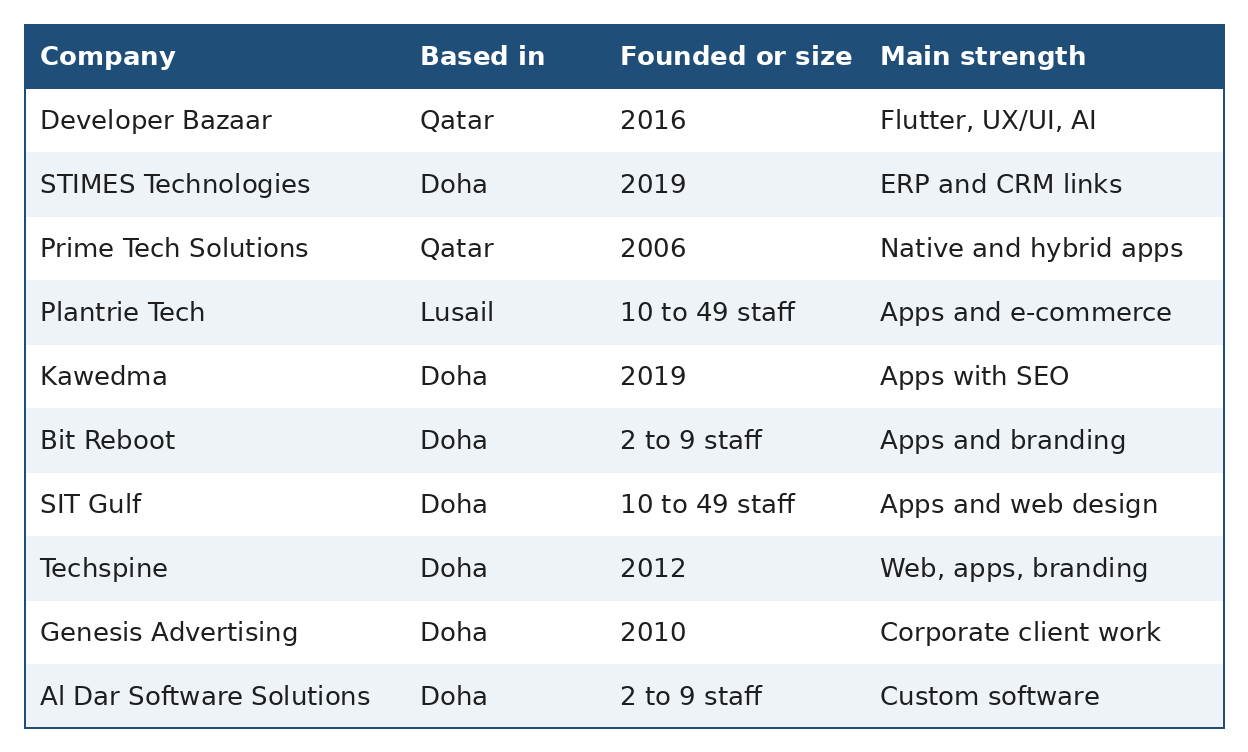
    comparison_table.png

    Qatar Details Worth Testing Before You Sign

    Ask every team to demo five local checks: a screen switched to Arabic with correct mirroring, dates shown in Hijri and Gregorian, a schedule set to a Friday and Saturday weekend, push notifications timed around Ramadan hours, and a phone field that accepts Qatar’s +974 country code. These checks take ten minutes and show how much local experience a team really has.

    What Drives the Price

    The Cost To Develop an App in Qatar depends on platform count, Arabic and English screens, payment links, admin tools and post-launch support. Directory listings for small Doha firms show minimum project sizes that start at $1,000 and $5,000, but those are floors, not quotes. Ask for a line-by-line estimate that separates design, build, testing and the first year of upkeep.

    How to Pick From This List

    Narrow the ten to three, send each the same feature list and compare how they respond. The best App Development Companies in Qatar ask about your users, languages and payment methods before naming a price. If you prefer to hire app developers in Qatar on a monthly basis, ask who owns the source code and store accounts.

    Also compare how each team answers a vague brief: good ones push back with questions, while weaker ones simply agree and quote.
    Treat these Top App Development Companies in Qatar as a starting pool, and ask each for a live bilingual app, a reference you can call and a written plan for support after launch.


  • 10 Telehealth App Development Companies in the USA
    A aditya-parmar

    I spent a few evenings going through directory profiles and published case studies while helping think through a virtual care build, and figured the notes might save someone else the same digging. Most telehealth app development companies look identical on their websites, so I tried to pull out the one or two things that actually separate them.

    Quick context for why this matters right now: Congress extended Medicare’s telehealth flexibilities through the end of 2027, which gives providers a longer runway than they had a year ago. That is usually when teams stop talking about telehealth and start budgeting for it.

    How I picked the list

    I wanted a mix, not a leaderboard. Some are small and specialised, some are huge, a couple are remote teams that work with US clients. For each one I looked for a public Clutch or GoodFirms profile, healthcare work they have actually shipped, and any detail that would change how I would brief them. If you are comparing the top telehealth app development companies yourself, treat this as a starting list and re-check every rating, rate and team size before you rely on it. Directory numbers move.

    10 Telehealth App Development Companies in the USA

    1. Developer Bazaar

    • Headquartered in Indore, India since 2016, with a US office in Fremont, California (41112 Mission Blvd, Suite 202) and another in Dubai. The Fremont address gives US clients a local contact point for contracts and kickoff calls.
    • Describes itself as AI-native: AI integration, agentic AI, generative AI, NLP and voice AI automation, plus mobile and product engineering, built on tools such as OpenAI, LangChain and AWS.
    • Directory profiles list recognition from Clutch (2017), GoodFirms (2018) and an ISO certificate (2021), so there is a public track record you can check.
    • Ask how work is split between the Fremont office and the Indore team, and who owns HIPAA and BAA paperwork.

    2. Arkenea

    • Chicago based, founded in 2011, and it works only in healthcare and life sciences, which is unusual for a vendor of this size.
    • Listed at $25 to $49 an hour with 20 to 30+ Clutch reviews averaging 4.9.
    • Covers telemedicine apps, custom EHR or EMR work and generative AI features aimed at clinical use.
    • Reportedly pairs the build with product and go-to-market advice, which helps first-time founders.

    3. Itransition

    • Founded in 1998 with 1,500+ people and offices across the US, UK, Poland, Lithuania, the UAE, Mexico and Germany, among others.
    • Holds ISO 9001, ISO/IEC 27001 and ISO/IEC 15408 certifications, which large hospital buyers often ask for.
    • Builds to HIPAA, CCPA, GDPR and Canada’s PIPEDA, handy if you will serve patients in more than one country.
    • Minimum project size is around $25,000 at $25 to $49 an hour, so it suits bigger programmes more than small pilots.

    4. Empeek

    • Based in Leander, Texas, founded in 2015, with 50 to 249 people, a $10,000 minimum and $25 to $49 an hour. Clutch reviews show projects from about $4,000 up to $300,000.
    • Often works as an extra team inside the client’s own developers, and sometimes steps in to rescue a build. One telehealth client had its code cleaned up, bugs fixed and database moved in 2024.
    • Covers EHR, telemedicine, remote patient monitoring, medication management and patient portals with HIPAA and HITECH in mind.
    • Holds a 5.0 on Clutch, but the review count is modest, so ask for a call with a recent client.

    5. Thinkitive

    • Founded in 2015 and headquartered in Pune, India, with a US entity in Dover, Delaware and 250 to 999 people. Listed at $25 to $49 an hour with a $25,000 minimum.
    • GoodFirms shows roughly 80 percent of its focus on healthcare, so you are not hiring a generalist.
    • Its telemedicine page highlights virtual waiting rooms, group visits that let care team members join, and real-time edits to the patient record during a call.
    • One client testimonial on its site mentions a 3 to 4 month delivery against 18+ months quoted elsewhere. Treat that as a claim to verify.

    6. Interexy

    • Headquartered in Miami with development offices in Dubai and Poland, founded in 2017, with 120+ people and rates of $25 to $49 an hour.
    • Says it has 70+ developers working on telemedicine and 15+ custom digital health platforms delivered.
    • Pitches a HIPAA-minded MVP in about three months, with video visits, EHR integration and virtual waiting rooms as standard building blocks.
    • Miami’s large Spanish-speaking patient base is a good prompt to ask about bilingual patient experiences.

    7. Dogtown Media

    • Los Angeles area studio, founded in 2011, with 20+ Clutch reviews averaging 4.8.
    • One of the pricier names on this list at $150 to $199 an hour.
    • Known for mHealth work such as clinical trial apps, remote monitoring and companion apps for medical devices, built with HIPAA in mind.
    • Design-forward, so it suits consumer health products where user experience decides whether people stay.

    8. Chop Dawg

    • Philadelphia, founded in 2009, with 10 to 49 people and 500+ apps launched. Clutch lists $50 to $99 an hour.
    • Works on fixed monthly budgets with an MVP-first plan, which makes spending easier to predict.
    • Clutch projects range from about $10,000 to $350,000, so there is room for both pilots and bigger builds.
    • Says it built a HIPAA-compliant prescription management platform used by providers across 17+ states.

    9. OSP

    • Founded in 2009 with 400+ people in the US and India, and says it has delivered 700+ healthcare projects. Listed at $25 to $49 an hour with a $5,000 minimum.
    • Works to HIPAA, SOC 2 and ISO 27001 standards, which is useful if a hospital security team will review you.
    • Telemedicine features it names include appointment scheduling, chatbots, payment gateways and e-prescriptions.
    • Also builds practice management software and custom EHRs, so it can cover the systems around your app.

    10. Cleveroad

    • Founded in 2011, with a US address in Claymont, Delaware and offices in Norway and Estonia. Reports 75+ Clutch reviews averaging 4.9, which you should cross-check on the directory itself.
    • Holds ISO 9001:2015 and ISO/IEC 27001:2013 certificates and is an AWS Partner Network member.
    • Mentions HL7 and FHIR integration and connections to systems such as Epic and Cerner.
    • Says it rescued and delivered a teledermatology platform for a Silicon Valley biotech after reviewing its inherited code, a good example of what a takeover looks like.

    What I would check before choosing

    The single most useful filter is whether a team has built exactly the kind of product you need. A good telehealth app development company should be able to show a working video visit flow, explain how it stores and logs protected health information, and name the EHRs it has connected to. Ask for a signed business associate agreement early, not after you have picked them.

    If you are still mapping the scope, read up on how to build a telemedicine platform before you request quotes. Knowing your user roles, visit types and integrations makes proposals far easier to compare, and it stops you paying for features you do not need yet.

    Build or buy?

    A lot of teams get stuck here. A ready-made platform is quicker to launch, and a custom build gives you control of the code, the roadmap and the patient experience. When you compare, look at White Label Telemedicine Platform Cost across a few years, not just the launch fee, because licence charges, per-user pricing and customisation all add up. Ask each vendor what happens to your data and branding if you leave.

    Final thought

    The best telehealth app development companies are not always the biggest names. They are the ones that answer compliance questions plainly, show recent live work and tell you what they would not build. If you shortlist from these telehealth app development companies in USA, ask each the same ten questions and compare the answers side by side.

    What did you look for when you hired a telehealth partner, and what do you wish you had asked earlier? I would like to hear what worked.


  • 8 Grocery Delivery Application Development Companies for Building Apps Like Instacart
    A aditya-parmar

    Anyone who has tried to scope an Instacart-style product knows it is not one app. It is four connected products: a customer app, a shopper or driver app, a store or vendor panel, and an admin dashboard all running on the same live inventory, order status, and payment data. That is why choosing among Grocery Delivery Application Development Companies takes longer than expected, and why a polished portfolio alone does not tell you much.

    This shortlist of the top Grocery Delivery Application Development Companies avoids the names that appear on every list. For each company, the focus is on what is specific to its approach: business-model coverage, technical architecture, delivery operations, integrations, or marketplace structure.

    Why Grocery Apps Are Harder Than Food Delivery

    Grocery delivery creates operational problems that ordinary food-delivery apps do not always face: thousands of SKUs, frequent stock-outs, substitutions, weight-based pricing, cold-chain items, scheduled delivery windows, and store-level inventory. A capable On-Demand Grocery Delivery App Development partner must therefore design for operations, not only for checkout and tracking.

    The companies below differ in how they solve that problem. Some are better for quick white-label launches, others for custom marketplaces, and others for enterprise-grade POS and ERP integrations.

    8 Grocery Delivery Application Development Companies

    1. Developer Bazaar Technologies

    Developer Bazaar is a software company with more than 10 years of experience across mobile, web, AI, and custom software. Its grocery work follows the four-app structure required for a marketplace: customer app, delivery-partner app, vendor or store panel, and admin dashboard.

    • Reports 200+ delivered projects, including 9+ large-scale grocery platforms.
    • Includes real-time tracking, secure payments, inventory management, product catalogs, coupons, and order management as standard grocery capabilities.
    • Has experience in telemedicine, education, fitness, and social apps, which helps when a grocery platform needs complex multi-role workflows.
    • Offers AI development as a separate service, useful for smart substitutions, recommendations, demand forecasting, and support automation.

    Developer Bazaar is a strong option for grocery delivery application development businesses that want a customizable grocery marketplace rather than a rigid template. Its experience with multi-role platforms is particularly relevant for vendors, dark stores, and multiple fulfillment locations.

    2. Ace Infoway

    Ace Infoway is unusually transparent about discovery, architecture, timelines, and cost. Its grocery approach begins with a discovery sprint covering retailer ecosystems, shopper behavior, delivery zones, and compliance requirements by market.

    • Uses React Native, Node.js with GraphQL, PostgreSQL with Redis, and Google Maps for tracking and delivery operations.
    • Offers a prebuilt integration framework for common retailer POS systems, which the company says can reduce time to market by 30–40% for mid-market builds.
    • Publishes indicative budgets: 40,000–80,000 for a single-retailer MVP, 120,000–250,000 for a multi-retailer, multi-city platform, and $350,000+ for national aggregators.
    • Plans 14–20 weeks for an MVP, while larger builds may require 24–36 weeks or more.

    Ace Infoway suits teams that want structured discovery and clearer financial planning before committing to a full build. Its POS-integration focus is especially useful for established retailers with existing inventory systems.

    3. AppsRhino

    AppsRhino is a Chicago-based company that builds white-label and custom on-demand apps across grocery, alcohol, laundry, home services, taxi, and logistics. Its cross-industry delivery experience can help when a grocery product needs mature driver workflows, automated assignment, and analytics.

    • Builds customer, delivery-agent, store-manager, and administrator applications within one grocery solution.
    • Includes real-time in-app chat between customers, stores, and drivers to resolve substitutions, address issues, and delivery questions quickly.
    • Supports both home delivery and scheduled store pickup, along with live tracking, promotions, ratings, and reviews.
    • Emphasizes PCI DSS-aligned payment handling and supports multiple payment gateways, including Stripe, Braintree, and PayPal.

    AppsRhino’s clearest strength is operational communication. In grocery delivery, chat is not a luxury: it is often how customers and shoppers resolve missing items, replacements, and delivery instructions without canceling the order.

    4. Webkul

    Webkul’s roots in marketplace and eCommerce software show clearly in its hyperlocal food and grocery products. Rather than treating grocery as an isolated mobile app, it approaches it as a marketplace system with vendors, delivery personnel, location rules, and inventory management.

    • Offers a hyperlocal marketplace, grocery app, and delivery-person management app with real-time inventory and route optimization.
    • Lets merchants define service areas, delivery rates, and store coverage by geography, an important capability for multi-store grocery businesses.
    • Built My Choicyes, an online marketplace for a supermarket in Midwood, Brooklyn.
    • Builds SaaS products across 30+ technologies, which helps when the grocery app must connect with ERP, POS, accounting, or existing eCommerce systems.

    Webkul is particularly suited to multi-store marketplaces rather than single-store apps. Its hyperlocal architecture where customers see nearby sellers based on location and merchants control delivery zones can be a major advantage for regional grocery networks.

    5. OyeLabs

    OyeLabs focuses on customizable, AI-enabled delivery platforms with strong attention to dispatch, tracking, and monetization. Its grocery work includes the customer, store, delivery, and admin layers needed to run a multi-sided grocery business.

    • Builds AI-enabled delivery products with intelligent dispatch, real-time GPS tracking, and PCI-compliant payment support.
    • Includes delivery-partner tools such as availability toggles, profile management, digital wallets, order history, GPS navigation, and status updates.
    • Provides store-side inventory management, payment management, and order notifications, helping reduce mismatches between what customers see and what stores can fulfill.
    • Offers AI add-ons such as smart order scheduling, intelligent chat support, personalized recommendations, dynamic routing, and ML-based upselling.

    OyeLabs is a good fit for founders who want a modern grocery platform with AI-led engagement and dispatch features. Its focus on delivery-partner tooling also makes it relevant for businesses building a large independent driver network.

    6. Folio3

    Folio3 approaches grocery delivery as a data-connected retail system. Its FoodTech practice emphasizes AI running on live operational data, with customer, vendor, driver, admin, and store views connected to the same ERP and POS records.

    • Connects customer, restaurant/vendor, driver, and admin views to shared ERP and POS records, so a stock-out can remove an item from the customer app in near real time.
    • Offers predictive dispatch, automatic stock-out handling, demand forecasting, and AI models trained on a business’s own order history.
    • Includes smart delivery zones, geofencing, route optimization, automated settlements, and driver payouts through its white-label admin toolkit.
    • Supports AI chatbots, predictive analytics, and dynamic pricing engines for businesses that want automation beyond basic ordering.

    Folio3 is best for grocery businesses that already have store systems, supply-chain data, or multi-location operations. Its strength is connecting the app to the operational data that determines whether orders can actually be fulfilled.

    7. TriState Technology

    TriState Technology emphasizes user-centered design, agile delivery, and analytics-led grocery experiences. This makes it a practical choice for companies that want to launch, measure, and improve features over time rather than build everything at once.

    • Applies user-centered design and agile development methods to grocery app projects.
    • Builds advanced search and filtering experiences that help shoppers find products by category, dietary preference, price, brand, and availability.
    • Provides analytics and insights to help businesses understand orders, customer behavior, conversion, and operational performance.
    • Supports personalization and customization, allowing grocery brands to differentiate their app beyond a standard product catalog.

    TriState is worth considering if your roadmap includes continuous experimentation, customer insights, and iterative feature releases. It is especially useful for grocery brands that want to improve basket size and retention through data-led UX decisions.

    8. Nimble AppGenie

    Nimble AppGenie offers a broad grocery feature set that covers customer convenience, inventory control, delivery routing, and in-store technology integration. Its approach is useful for retailers that want to connect digital ordering with physical store operations.

    • Builds customer apps with quick sign-up, product filters, multiple payment methods, real-time delivery updates, and support features.
    • Includes inventory tools such as low-stock alerts, product updates, and stock-level tracking.
    • Provides GPS-enabled delivery routing and real-time order-status updates for delivery teams.
    • Explores advanced capabilities such as AI-based recommendations, contactless delivery, QR-code interactions, and IoT-supported store operations.

    Nimble AppGenie is a strong match for grocery businesses seeking a feature-rich platform that can extend beyond delivery into smarter store operations. Its combination of inventory alerts, routing, and in-store technology makes it relevant for retailers with physical stores.

    Clone or Custom Build?

    If you want to test demand quickly, an Instacart Clone App or a DoorDash clone script can reduce initial build time. These routes work best when your goal is to validate a defined delivery radius, a limited catalog, and a simple order flow.

    The limitations usually appear after real order volume arrives. Catalog structure becomes harder to manage, inventory sync becomes critical, substitutions need clear rules, and driver dispatch must handle peak-hour demand. At that stage, the difference between a template and a custom platform becomes operational, not just visual.

    Whichever route you choose, grocery delivery succeeds or fails on three fundamentals: accurate inventory, dependable payments, and real-time delivery visibility.

    How to Choose the Right Company

    • Use a short comparison process rather than choosing based on a sales deck or portfolio screenshots.
    • Ask for a live grocery app demo, including vendor and driver sides, not only customer-facing screens.
    • Ask how inventory syncs with a store’s POS or ERP system, and what happens when an item goes out of stock during picking.
    • Ask who owns the source code, hosting environment, map API accounts, and third-party integrations.
    • Request a written estimate that separates build cost from hosting, map usage, SMS, payment processing, maintenance, and future feature work.
    • Run a small paid discovery phase with two or three shortlisted companies before committing to a full build.

    Final Word

    The best Grocery Delivery Application Development Companies for your project depend on your model: a single store, a supermarket chain, a multi-vendor marketplace, or a quick-commerce operation with dark stores. Developer Bazaar, Ace Infoway, AppsRhino, Webkul, OyeLabs, Folio3, TriState Technology, and Nimble AppGenie each solve a different part of that problem.

    Use this list as a starting point, then compare shortlisted teams on discovery quality, inventory architecture, delivery operations, and post-launch support. A grocery platform is ultimately an operations product with a storefront on top and the right development partner should understand both sides.


  • Top 7 Telehealth App Development Companies for Hospitals and Private Clinics
    A aditya-parmar

    A hospital does not only need a video-call button. A private clinic does not only need an appointment calendar.

    When a patient books a consultation, shares a report, joins a video call, receives a prescription, and returns for follow-up, several systems need to work together. The app must support the patient's experience, the clinician's workflow, and the administrative team managing appointments, records, and payments.

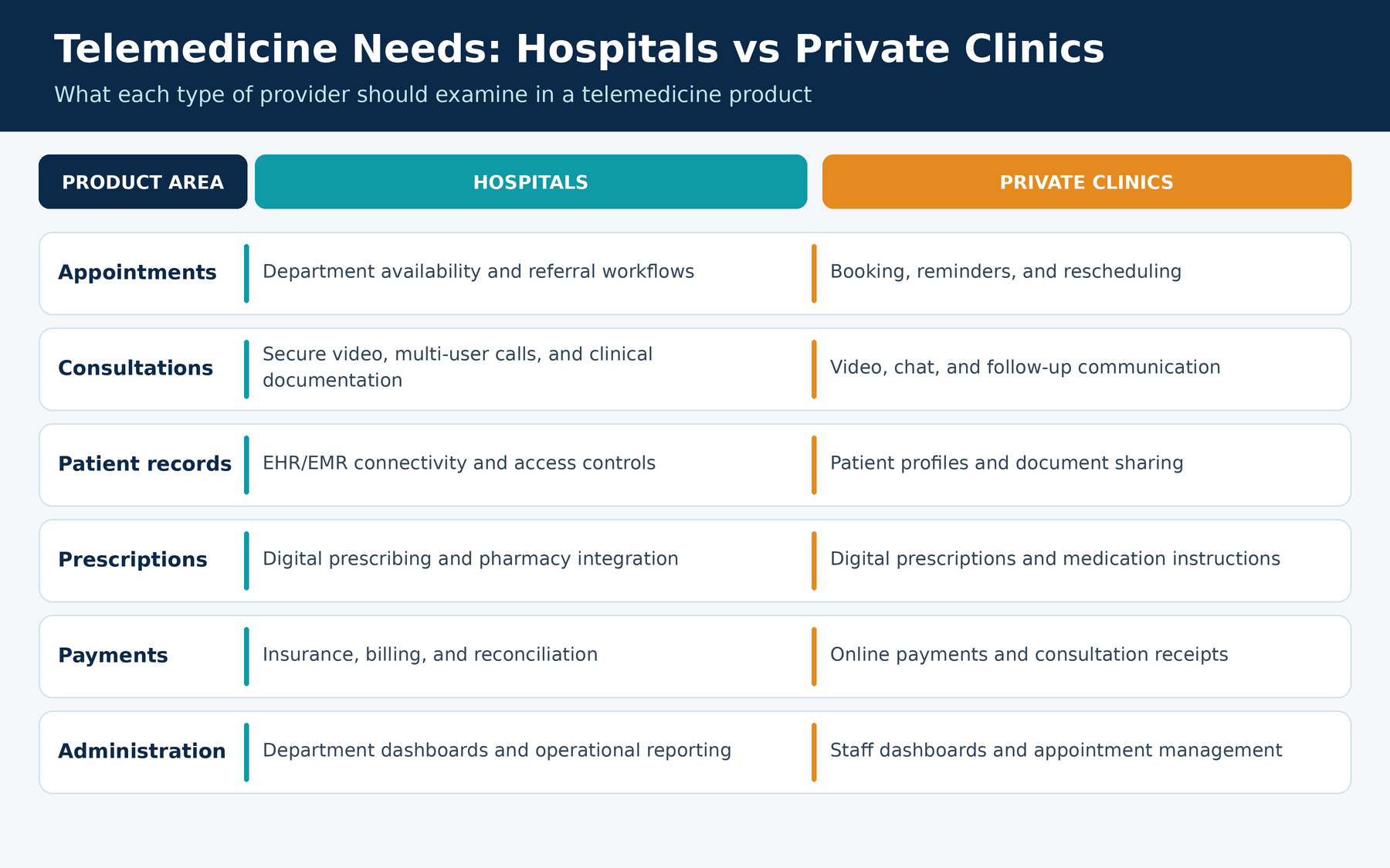
    That is why choosing among the Top Telehealth App Development Companies requires more than comparing attractive interfaces. A hospital may need EHR connectivity, role-based access, and scalable consultation infrastructure. A private clinic may prioritize quick booking, reminders, secure messaging, and simple follow-up workflows.

    This guide compares seven providers for hospitals and private clinics. Developer Bazaar Technologies appears first, followed by providers with relevant local or healthcare-focused offerings. This is an editorial shortlist, not an independently scored ranking, so use it as a starting point for further research.

    What Hospitals and Clinics Need From a Telehealth Platform

    Telehealth is not one fixed product. A hospital may need a platform that connects departments, clinicians, patient records, and remote-monitoring tools. A private clinic may need a simpler product focused on bookings, consultations, payments, and follow-up communication.

    Before comparing Telehealth App Development Companies, define your care model. Will patients book scheduled appointments or connect with an available doctor? Will consultations include video, chat, document sharing, or asynchronous reviews? Does the platform need to connect with an existing EHR, billing system, or pharmacy workflow?
    hospitals-vs-clinics-telemedicine.png

    A useful project brief describes the complete journey: what patients do before, during, and after consultations, what clinicians need to review, and what the administrative team must manage.

    7 Best Telehealth App Development Companies

    1. Developer Bazaar Technologies

    Developer Bazaar Technologies offers custom healthcare and telemedicine applications for Android, iOS, and web platforms. Its published services include virtual consultations, appointment scheduling, secure communication, patient management, and healthcare integrations.

    For hospitals and clinics seeking a custom product, the company is worth evaluating when patient-facing features and clinical operations need to work together. The best telehealth app development company for a particular project should be selected based on relevant experience, technical scope, security responsibilities, and ongoing support not rankings alone.

    What to consider:

    • Telehealth features: Virtual consultations, appointment scheduling, secure messaging, patient dashboards, and digital prescriptions.
    • Hospital and clinic fit: Discuss patient apps alongside the systems supporting appointments, records, and clinical operations.
    • Distinctive consideration: Its custom development offering is relevant when a provider wants to connect remote consultations with existing healthcare workflows rather than launch a standalone video-calling feature.
    • Question to ask: “Which parts of our current patient and clinician workflows would you integrate with, and which would you recommend rebuilding?”

    2. TekRevol

    TekRevol has a Doha office and publishes healthcare app development services covering appointment booking, patient scheduling, remote consultations, EHR/EMR integration, and remote patient monitoring.
    Its Qatar presence makes it relevant for hospitals and clinics that prefer discussing project requirements with a provider that lists a local office. Its healthcare service claims should still be checked against the requirements of the individual project.

    What to consider:

    • Telehealth features: Patient scheduling, remote consultations, and EHR/EMR integration.
    • Local relevance: Its Qatar page references local healthcare organizations and regulatory considerations. Ask how those requirements apply to your project.
    • Distinctive consideration: Request case studies that demonstrate relevant healthcare delivery experience and clarify which team members would work on your platform.
    • Question to ask: “How would you connect our telehealth app with existing clinical systems without disrupting daily operations?”

    3. Carmatec

    Carmatec offers healthcare software development covering telehealth, remote patient monitoring, medical-record management, appointment systems, and IoT medical-device integration.

    Its published healthcare material includes a MedX project involving patient and physician applications, chat, video conferencing, call recording, and integration with existing mobile and web interfaces. This gives prospective buyers a specific project reference to investigate.

    What to consider:

    • Telehealth features: Digital consultations, patient engagement, workflow automation, and reporting.
    • Portfolio reference: Ask how the MedX implementation handled integration, privacy, and operational requirements.
    • Distinctive consideration: Its published Qatar healthcare offering also discusses bilingual AI tools for appointment operations, reminders, rescheduling, and documentation support.
    • Question to ask: “How would you separate administrative automation from clinical decision-making in our platform?”

    4. Zoondia

    Zoondia serves businesses in Qatar across areas including healthcare, retail, fintech, and logistics. Its published services include Android and iOS development, Flutter, React Native, wearable apps, and custom enterprise solutions.
    This profile may suit hospitals and clinics that need a mobile-first product connected to broader operational systems or are considering remote monitoring alongside virtual consultations.

    What to consider:

    • Healthcare capabilities: Healthcare apps, wearable applications, and custom enterprise solutions.
    • Delivery scope: Requirements analysis, UI/UX design, architecture, development, integrations, testing, deployment, and ongoing support.
    • Distinctive consideration: Its mobile, wearable, and enterprise development offerings provide a basis for discussing how remote-monitoring data could reach clinicians.
    • Question to ask: “Which monitoring data would our clinicians need to see, and how would it reach them securely?”

    5. Banao Technologies

    Banao Technologies offers healthcare software development in Qatar, including patient-focused mobile applications, EHR systems, and telemedicine platforms. Its published Qatar page specifically discusses remote consultations and secure video conferencing.

    For providers building in the Qatari healthcare environment, its local service information provides a starting point for discussing platform requirements and integration needs.

    What to consider:

    • Telehealth features: Remote consultations and secure video conferencing.
    • Local relevance: Its Qatar page references healthcare guidelines and requirements. Confirm the specific standards and responsibilities relevant to your organization.
    • Distinctive consideration: Its published offering connects telemedicine with electronic health records, making it relevant when consultation and record workflows need to work together.
    • Question to ask: “Which local healthcare requirements would affect the architecture, data flow, and user access controls?”

    6. QArea

    QArea offers telemedicine development through its healthcare practice. Its published service page describes telehealth software development for businesses planning a telemedicine platform.

    It is worth including in an initial shortlist for buyers who want to discuss a dedicated telehealth product rather than a general mobile application. However, prospective customers should ask for examples relevant to their clinical setting.

    What to consider:

    • Telehealth focus: Telemedicine platform development and telehealth software solutions.
    • Experience to verify: Request healthcare project references and clarify which parts of the proposed product the team would deliver.
    • Distinctive consideration: Its dedicated telemedicine service page provides a starting point for a platform-specific discussion.
    • Question to ask: “What would you include in a first-release telehealth platform for our type of clinic?”

    7. Nova Labs

    Nova Labs is a Qatar-based development house focused on app development, web development, design, and prototyping for startups and corporate innovation.
    Its product-development focus may be relevant to clinics or hospital departments planning a new digital-care service. Before selecting it for a healthcare project, verify its experience with comparable applications and sensitive data workflows.

    What to consider:

    • Development services: App development, web development, design, and prototyping.
    • Experience to verify: Request healthcare or comparable delivery-project references before relying on general capability claims.
    • Distinctive consideration: Its prototyping focus creates an opportunity to test patient and clinician workflows before committing to full-scale development.
    • Question to ask: “What would you prototype first to test the patient booking and consultation journey?”

    How to Compare Telehealth Development Proposals

    A search for Top Telehealth Application Development Services will produce many broad claims. A more useful comparison begins when every company receives the same project brief.

    Instead of asking only, “How much will a telehealth app cost?”, describe a complete workflow:
    A patient books a follow-up, uploads a report, pays for the consultation, joins a video call, and receives instructions afterward.

    Ask each provider to explain:

    • Which platforms and features are included in the first release.
    • Which integrations are required and whether third-party fees apply.
    • What could increase the cost or delay launch.
    • How testing and deployment will be managed.
    • What maintenance and support are included after launch.
    • Who owns the source code, documentation, and developer accounts.

    Then introduce exceptions, such as a canceled appointment, failed payment, disconnected call, or prescription requiring additional review. The useful answer is not simply a list of features; it is an explanation of how the proposed product will handle real workflows.

    Make Compliance Discussions Specific

    Healthcare software providers may describe their products as HIPAA-compliant. Treat such statements as a starting point for due diligence, not as a substitute for reviewing your project's legal, regulatory, and security requirements.

    Ask vendors to explain access controls, data flows, encryption, audit logging, third-party dependencies, and security responsibilities. Clarify what the development team will implement and document, and what remains the responsibility of your organization.

    For Qatar-based providers, confirm the applicable local data-protection and healthcare requirements with qualified advisers. Avoid accepting “the app will be compliant” as a complete answer.

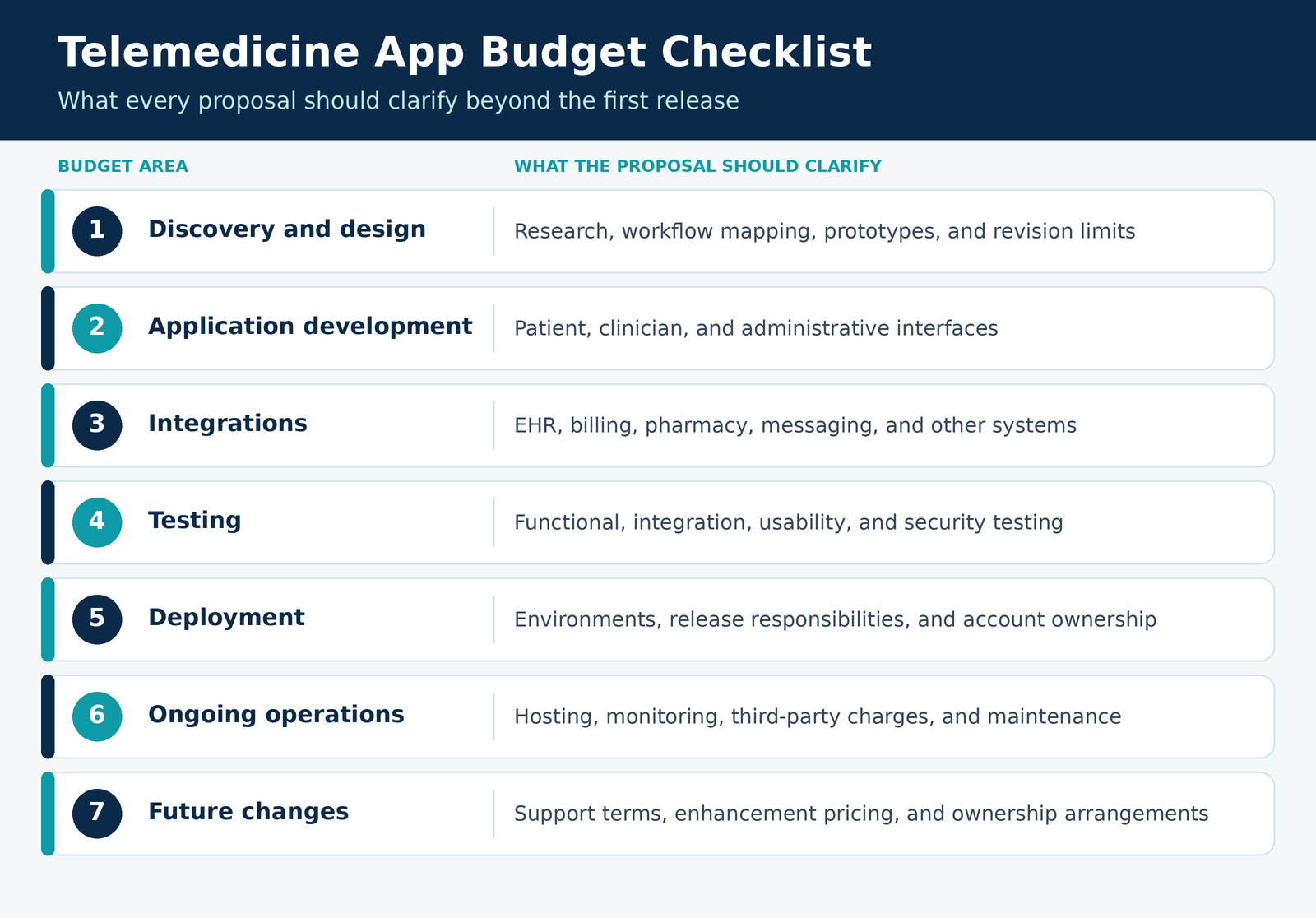
    Budget Beyond the First Release

    There is no universal price for a telehealth app without an agreed scope. The number of platforms, design requirements, integrations, security controls, and clinical workflows can all affect the final estimate.

    Use a telemedicine app development cost guide to organize your initial budget, not as a fixed price for every project.
    telemedicine-budget-checklist.png

    Before you Hire Telemedicine App Developers, compare proposals against the same brief. A lower estimate may simply include fewer features or exclude integrations, testing, or post-launch support.

    You can also review Best HIPAA Compliant Telehealth Platforms when evaluating security-focused products. Assess compliance through written requirements and verified controls rather than marketing language alone.

    Should You Consider a Teladoc-Style Model?

    A Teladoc-style model can be a useful starting point for discussing a telehealth marketplace, but it does not replace a clear operational brief.

    When exploring Teladoc Clone App Development, define the consultation model, provider network, patient journey, payment process, and follow-up workflow. A familiar app model should guide the discussion, not replace decisions about clinical workflows, access controls, and integrations.

    Frequently Asked Questions

    1. How do I choose a telehealth app development company for a hospital or private clinic?
    Start by defining your consultation workflows, patient and clinician requirements, existing systems, and security obligations. Compare providers based on relevant healthcare experience, integration capabilities, testing practices, source-code ownership, and post-launch support. Ask each company to demonstrate how it would handle your actual workflow rather than relying on a general feature list.

    2. What features should a telehealth app include?
    Common features include appointment scheduling, secure video consultations, patient profiles, document sharing, notifications, and follow-up communication. Depending on the care model, a hospital may also need EHR/EMR integration, role-based access, digital prescriptions, reporting, and remote patient monitoring. The final feature set should reflect clinical needs, applicable requirements, and the budget.

    3. How much does it cost to develop a telehealth app?
    The cost depends on the number of platforms, the complexity of patient and clinician workflows, integrations, security requirements, and testing needs. A basic consultation app will usually require less work than a platform with multiple user roles, EHR integration, payment processing, and remote monitoring. Request an itemized proposal that separates development, integrations, testing, deployment, and ongoing maintenance.

    Final Thoughts

    There is no single telehealth app development company that will be the right fit for every hospital or clinic. A local provider may be preferable when regional context and in-person collaboration matter. A remote team may also be suitable if its healthcare experience, communication practices, and delivery arrangements meet your needs.

    The strongest shortlist is one based on relevant experience, verifiable project references, clear security responsibilities, and a proposal that explains how your telehealth service will work in practice. Speak with at least three providers, give them the same project brief, and compare the proposed scope before making a decision.

  • Top 5 Mobile App Development Companies in Qatar to Hire
    A aditya-parmar

    Hiring a mobile app development company in Qatar shouldn't mean picking whoever ranks highest on a paid search ad. It should mean picking a team that's actually delivered something similar to what you're building, in the market you're building it for. This list skips the international mega-agencies that show up in every generic ranking and sticks to teams with a genuine Doha or Qatar footprint, since local presence tends to matter more here than founders expect, local payment gateways, Arabic-English bilingual support, and an actual understanding of how business gets done in this market.

    If you're comparing options for the Top Mobile App Development Company in Qatar for your specific project, the five names below cover a reasonable spread: enterprise-grade work, design-focused builds, budget-conscious startups, and integration-heavy projects. Pick based on what your app actually needs, not just whoever's easiest to find. For a broader look at the wider market, App Development Services in Qatar covers more ground than this shortlist alone.

    1. Developer Bazaar Technologies

    • Built a reputation in Qatar on custom Android and iOS development rather than reskinned templates, with a portfolio spanning healthcare, retail, fintech, and logistics apps.
    • Clients consistently point to post-launch support as the reason they come back for a second or third project, which matters more than a polished pitch once the app is actually live and something breaks.

    If you're weighing a best mobile app development company in qatar against smaller local studios, Developer Bazaar is usually the first name that comes up in that comparison, and it tends to hold up once you dig into the specifics.

    2. Carmatec Qatar

    • Operates an actual Doha office opened back in 2015, and has worked directly with larger local institutions including Doha Bank and Qatar Insurance Group.
    • Brings genuine experience with compliance-heavy builds, useful if your app touches financial data or needs to satisfy stricter regulatory requirements than a typical consumer app.

    3. Doha Digital Solutions

    • Focuses on practical, budget-conscious builds aimed at local startups and small businesses rather than chasing large enterprise contracts.
    • Tends to move faster on timelines than bigger agencies, since projects are scoped tighter and don't carry the overhead of a large account management layer.

    4. QTech Mobile Labs

    • Built its reputation primarily around UI/UX quality, producing apps that feel noticeably more polished on the front end than a lot of budget-tier competitors.
    • A strong fit if user experience is the piece you genuinely can't afford to get wrong, a consumer-facing app where a clunky first session directly hurts retention.

    5. InterSmart Qatar

    • Handles the full pipeline from design through deployment under one roof, rather than passing a project between separate teams at different stages.
    • Positions itself specifically toward small and mid-sized businesses, aiming for a professional result without pricing that only makes sense for a much bigger company.

    What This Actually Costs

    Pricing varies more than most first-time founders expect, and it's rarely because one agency is simply better than another. Getting a realistic Cost To Develop an App in Qatar estimate depends on scope, whether you need native builds for both iOS and Android, how much backend infrastructure the app requires, and what level of post-launch support you're locking in. Get itemized quotes from at least two or three of the names above before committing, since a vague number upfront almost always turns into scope creep once development actually starts.

    If You'd Rather Hire In-House Instead

    Not every founder wants to hand a project to an agency, especially if the plan is to keep iterating on the product long after launch. If that's the direction you're considering, the process to Hire app developers in Qatar looks a lot like vetting an agency, just without the markup: check real shipped work instead of trusting a resume, ask direct technical questions in the interview, and be honest with yourself about whether you have the internal capacity to manage a developer without a project manager sitting in between.

    If You're Building on a Tight Budget

    Small businesses often assume a genuinely capable development team is out of reach financially, and that's not usually true in this market. A Mobile App Development Company in Qatar for Small Business doesn't have to mean cutting corners, it usually means picking a team that scopes tighter, skips unnecessary enterprise features you won't use for years, and prioritizes a functional MVP over a feature list built for a company five times your size.

    The Bottom Line

    All five names here have something real to point to, not just a claim on a homepage. Developer Bazaar and Carmatec lean toward bigger, more technically demanding builds. Doha Digital Solutions and InterSmart Qatar are better suited to founders working with a tighter budget and timeline. QTech Mobile Labs is the pick if design quality is non-negotiable. Whichever direction fits your project, ask for a live app you can actually download and test before signing anything. A portfolio screenshot tells you far less than an app that's still running with real users.


  • Is a DoorDash Clone Worth It for Food Delivery Startups?
    A aditya-parmar

    Good points on speed-to-market. One angle I’d add: a doordash clone is worth it mainly when you already have supply (restaurants/cloud kitchens) and a clear delivery zone mapped out. Without that, the tech advantage disappears fast.

    From what I’ve seen, the biggest post-launch headaches aren’t features but operations:

    • Keeping ETAs accurate during peaks without over-dispatching riders
    • Handling partial refunds and order edits without breaking the flow
    • Managing restaurant prep-time variability, which no script fully “solves”

    If you go the clone route, treat the first 60–90 days as a live pilot: launch in a tight area, measure cancellation rates, average delivery time, and rider utilization, then iterate on pricing and workflows before expanding. A doordash clone can accelerate that learning loop, but it won’t replace it.

  • Login

  • Don't have an account? Register

  • Login or register to search.
  • First post
    Last post
0
  • Categories
  • Recent
  • Tags
  • Popular
  • Users
  • Groups