
Top 7 Telehealth App Development Companies for Hospitals and Private Clinics
-
A hospital does not only need a video-call button. A private clinic does not only need an appointment calendar.
When a patient books a consultation, shares a report, joins a video call, receives a prescription, and returns for follow-up, several systems need to work together. The app must support the patient's experience, the clinician's workflow, and the administrative team managing appointments, records, and payments.
That is why choosing among the Top Telehealth App Development Companies requires more than comparing attractive interfaces. A hospital may need EHR connectivity, role-based access, and scalable consultation infrastructure. A private clinic may prioritize quick booking, reminders, secure messaging, and simple follow-up workflows.
This guide compares seven providers for hospitals and private clinics. Developer Bazaar Technologies appears first, followed by providers with relevant local or healthcare-focused offerings. This is an editorial shortlist, not an independently scored ranking, so use it as a starting point for further research.
What Hospitals and Clinics Need From a Telehealth Platform
Telehealth is not one fixed product. A hospital may need a platform that connects departments, clinicians, patient records, and remote-monitoring tools. A private clinic may need a simpler product focused on bookings, consultations, payments, and follow-up communication.
Before comparing Telehealth App Development Companies, define your care model. Will patients book scheduled appointments or connect with an available doctor? Will consultations include video, chat, document sharing, or asynchronous reviews? Does the platform need to connect with an existing EHR, billing system, or pharmacy workflow?
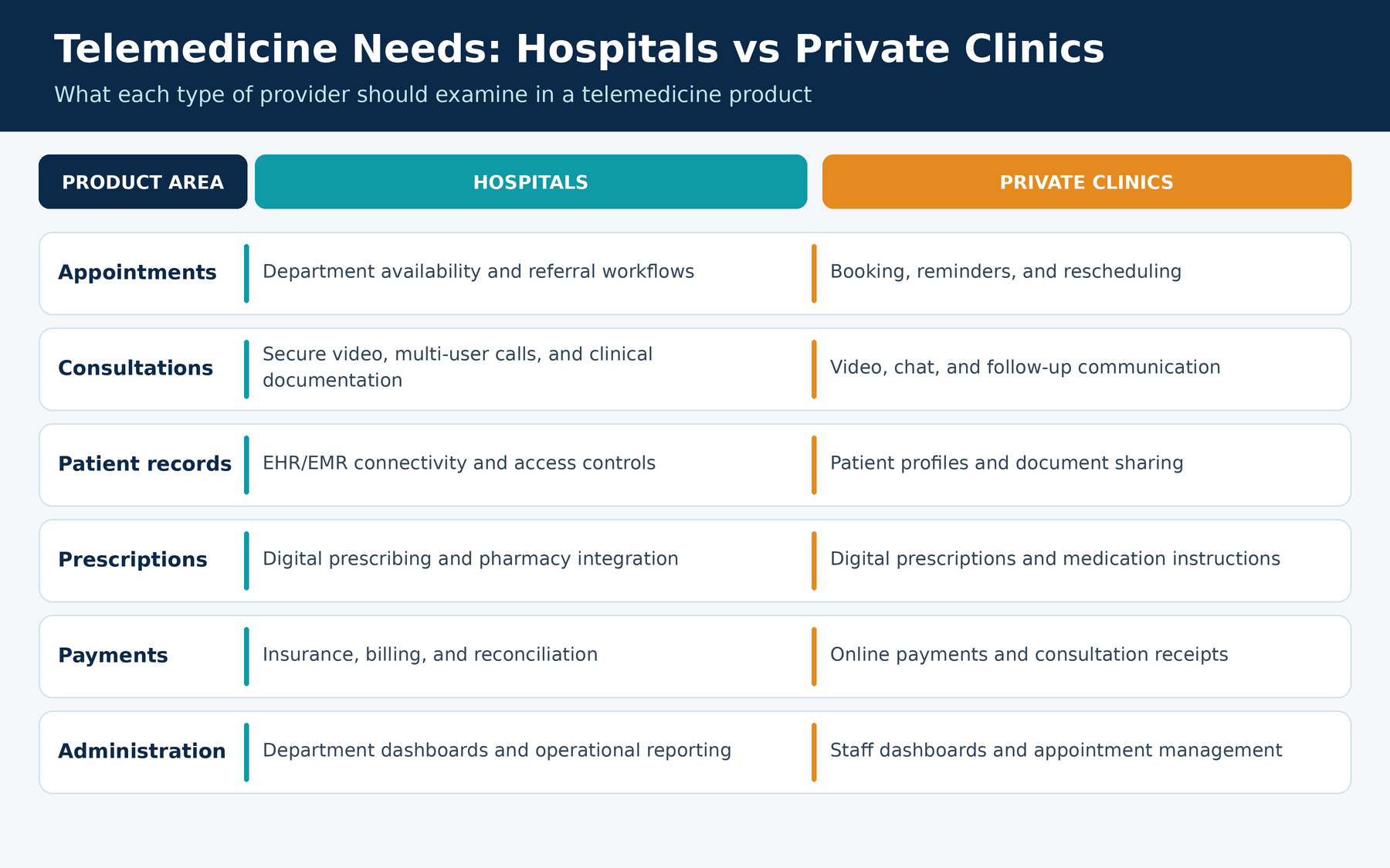
A useful project brief describes the complete journey: what patients do before, during, and after consultations, what clinicians need to review, and what the administrative team must manage.
7 Best Telehealth App Development Companies
1. Developer Bazaar Technologies
Developer Bazaar Technologies offers custom healthcare and telemedicine applications for Android, iOS, and web platforms. Its published services include virtual consultations, appointment scheduling, secure communication, patient management, and healthcare integrations.
For hospitals and clinics seeking a custom product, the company is worth evaluating when patient-facing features and clinical operations need to work together. The best telehealth app development company for a particular project should be selected based on relevant experience, technical scope, security responsibilities, and ongoing support not rankings alone.
What to consider:
- Telehealth features: Virtual consultations, appointment scheduling, secure messaging, patient dashboards, and digital prescriptions.
- Hospital and clinic fit: Discuss patient apps alongside the systems supporting appointments, records, and clinical operations.
- Distinctive consideration: Its custom development offering is relevant when a provider wants to connect remote consultations with existing healthcare workflows rather than launch a standalone video-calling feature.
- Question to ask: “Which parts of our current patient and clinician workflows would you integrate with, and which would you recommend rebuilding?”
2. TekRevol
TekRevol has a Doha office and publishes healthcare app development services covering appointment booking, patient scheduling, remote consultations, EHR/EMR integration, and remote patient monitoring.
Its Qatar presence makes it relevant for hospitals and clinics that prefer discussing project requirements with a provider that lists a local office. Its healthcare service claims should still be checked against the requirements of the individual project.What to consider:
- Telehealth features: Patient scheduling, remote consultations, and EHR/EMR integration.
- Local relevance: Its Qatar page references local healthcare organizations and regulatory considerations. Ask how those requirements apply to your project.
- Distinctive consideration: Request case studies that demonstrate relevant healthcare delivery experience and clarify which team members would work on your platform.
- Question to ask: “How would you connect our telehealth app with existing clinical systems without disrupting daily operations?”
3. Carmatec
Carmatec offers healthcare software development covering telehealth, remote patient monitoring, medical-record management, appointment systems, and IoT medical-device integration.
Its published healthcare material includes a MedX project involving patient and physician applications, chat, video conferencing, call recording, and integration with existing mobile and web interfaces. This gives prospective buyers a specific project reference to investigate.
What to consider:
- Telehealth features: Digital consultations, patient engagement, workflow automation, and reporting.
- Portfolio reference: Ask how the MedX implementation handled integration, privacy, and operational requirements.
- Distinctive consideration: Its published Qatar healthcare offering also discusses bilingual AI tools for appointment operations, reminders, rescheduling, and documentation support.
- Question to ask: “How would you separate administrative automation from clinical decision-making in our platform?”
4. Zoondia
Zoondia serves businesses in Qatar across areas including healthcare, retail, fintech, and logistics. Its published services include Android and iOS development, Flutter, React Native, wearable apps, and custom enterprise solutions.
This profile may suit hospitals and clinics that need a mobile-first product connected to broader operational systems or are considering remote monitoring alongside virtual consultations.What to consider:
- Healthcare capabilities: Healthcare apps, wearable applications, and custom enterprise solutions.
- Delivery scope: Requirements analysis, UI/UX design, architecture, development, integrations, testing, deployment, and ongoing support.
- Distinctive consideration: Its mobile, wearable, and enterprise development offerings provide a basis for discussing how remote-monitoring data could reach clinicians.
- Question to ask: “Which monitoring data would our clinicians need to see, and how would it reach them securely?”
5. Banao Technologies
Banao Technologies offers healthcare software development in Qatar, including patient-focused mobile applications, EHR systems, and telemedicine platforms. Its published Qatar page specifically discusses remote consultations and secure video conferencing.
For providers building in the Qatari healthcare environment, its local service information provides a starting point for discussing platform requirements and integration needs.
What to consider:
- Telehealth features: Remote consultations and secure video conferencing.
- Local relevance: Its Qatar page references healthcare guidelines and requirements. Confirm the specific standards and responsibilities relevant to your organization.
- Distinctive consideration: Its published offering connects telemedicine with electronic health records, making it relevant when consultation and record workflows need to work together.
- Question to ask: “Which local healthcare requirements would affect the architecture, data flow, and user access controls?”
6. QArea
QArea offers telemedicine development through its healthcare practice. Its published service page describes telehealth software development for businesses planning a telemedicine platform.
It is worth including in an initial shortlist for buyers who want to discuss a dedicated telehealth product rather than a general mobile application. However, prospective customers should ask for examples relevant to their clinical setting.
What to consider:
- Telehealth focus: Telemedicine platform development and telehealth software solutions.
- Experience to verify: Request healthcare project references and clarify which parts of the proposed product the team would deliver.
- Distinctive consideration: Its dedicated telemedicine service page provides a starting point for a platform-specific discussion.
- Question to ask: “What would you include in a first-release telehealth platform for our type of clinic?”
7. Nova Labs
Nova Labs is a Qatar-based development house focused on app development, web development, design, and prototyping for startups and corporate innovation.
Its product-development focus may be relevant to clinics or hospital departments planning a new digital-care service. Before selecting it for a healthcare project, verify its experience with comparable applications and sensitive data workflows.What to consider:
- Development services: App development, web development, design, and prototyping.
- Experience to verify: Request healthcare or comparable delivery-project references before relying on general capability claims.
- Distinctive consideration: Its prototyping focus creates an opportunity to test patient and clinician workflows before committing to full-scale development.
- Question to ask: “What would you prototype first to test the patient booking and consultation journey?”
How to Compare Telehealth Development Proposals
A search for Top Telehealth Application Development Services will produce many broad claims. A more useful comparison begins when every company receives the same project brief.
Instead of asking only, “How much will a telehealth app cost?”, describe a complete workflow:
A patient books a follow-up, uploads a report, pays for the consultation, joins a video call, and receives instructions afterward.Ask each provider to explain:
- Which platforms and features are included in the first release.
- Which integrations are required and whether third-party fees apply.
- What could increase the cost or delay launch.
- How testing and deployment will be managed.
- What maintenance and support are included after launch.
- Who owns the source code, documentation, and developer accounts.
Then introduce exceptions, such as a canceled appointment, failed payment, disconnected call, or prescription requiring additional review. The useful answer is not simply a list of features; it is an explanation of how the proposed product will handle real workflows.
Make Compliance Discussions Specific
Healthcare software providers may describe their products as HIPAA-compliant. Treat such statements as a starting point for due diligence, not as a substitute for reviewing your project's legal, regulatory, and security requirements.
Ask vendors to explain access controls, data flows, encryption, audit logging, third-party dependencies, and security responsibilities. Clarify what the development team will implement and document, and what remains the responsibility of your organization.
For Qatar-based providers, confirm the applicable local data-protection and healthcare requirements with qualified advisers. Avoid accepting “the app will be compliant” as a complete answer.
Budget Beyond the First Release
There is no universal price for a telehealth app without an agreed scope. The number of platforms, design requirements, integrations, security controls, and clinical workflows can all affect the final estimate.
Use a telemedicine app development cost guide to organize your initial budget, not as a fixed price for every project.
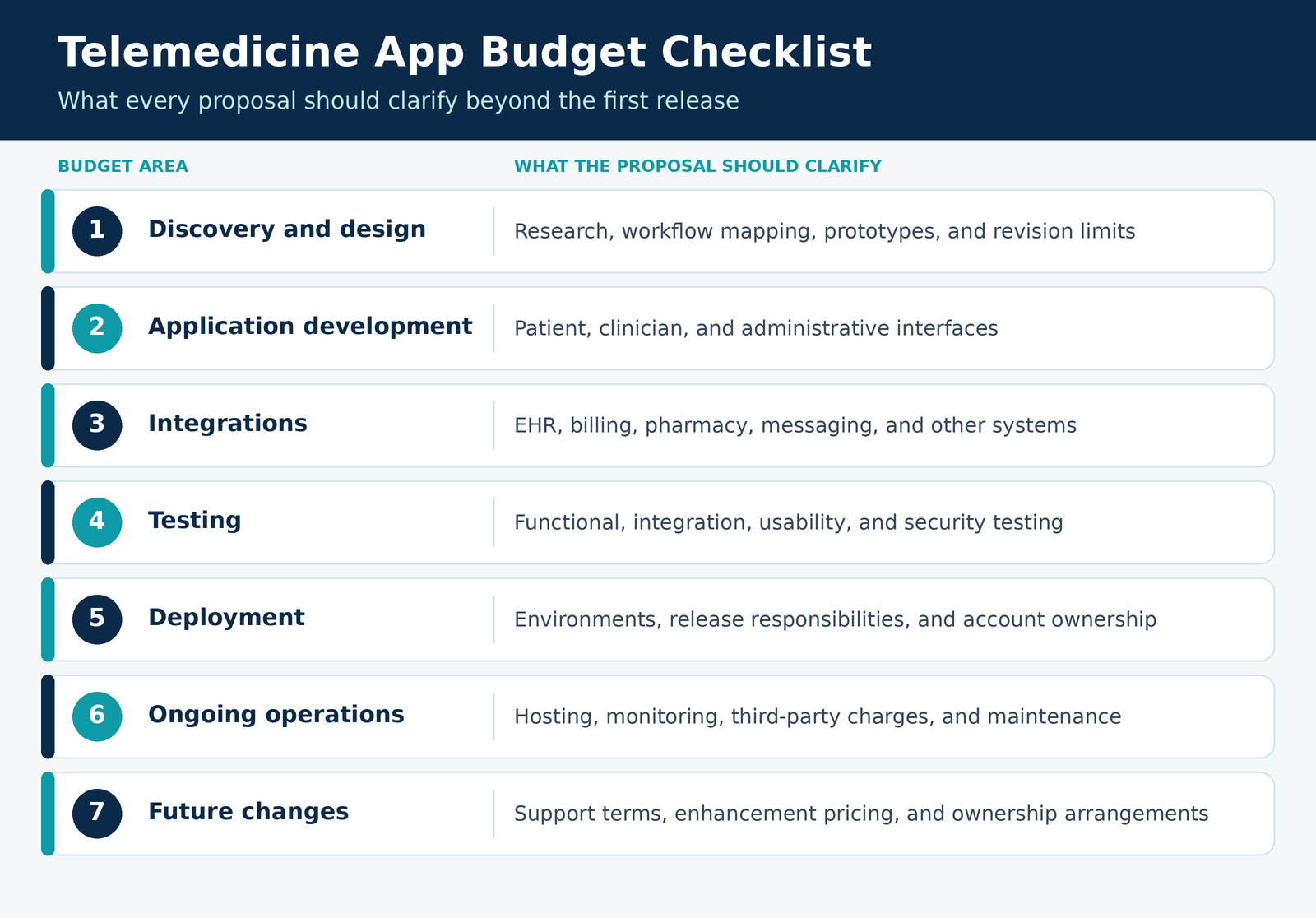
Before you Hire Telemedicine App Developers, compare proposals against the same brief. A lower estimate may simply include fewer features or exclude integrations, testing, or post-launch support.
You can also review Best HIPAA Compliant Telehealth Platforms when evaluating security-focused products. Assess compliance through written requirements and verified controls rather than marketing language alone.
Should You Consider a Teladoc-Style Model?
A Teladoc-style model can be a useful starting point for discussing a telehealth marketplace, but it does not replace a clear operational brief.
When exploring Teladoc Clone App Development, define the consultation model, provider network, patient journey, payment process, and follow-up workflow. A familiar app model should guide the discussion, not replace decisions about clinical workflows, access controls, and integrations.
Frequently Asked Questions
1. How do I choose a telehealth app development company for a hospital or private clinic?
Start by defining your consultation workflows, patient and clinician requirements, existing systems, and security obligations. Compare providers based on relevant healthcare experience, integration capabilities, testing practices, source-code ownership, and post-launch support. Ask each company to demonstrate how it would handle your actual workflow rather than relying on a general feature list.2. What features should a telehealth app include?
Common features include appointment scheduling, secure video consultations, patient profiles, document sharing, notifications, and follow-up communication. Depending on the care model, a hospital may also need EHR/EMR integration, role-based access, digital prescriptions, reporting, and remote patient monitoring. The final feature set should reflect clinical needs, applicable requirements, and the budget.3. How much does it cost to develop a telehealth app?
The cost depends on the number of platforms, the complexity of patient and clinician workflows, integrations, security requirements, and testing needs. A basic consultation app will usually require less work than a platform with multiple user roles, EHR integration, payment processing, and remote monitoring. Request an itemized proposal that separates development, integrations, testing, deployment, and ongoing maintenance.Final Thoughts
There is no single telehealth app development company that will be the right fit for every hospital or clinic. A local provider may be preferable when regional context and in-person collaboration matter. A remote team may also be suitable if its healthcare experience, communication practices, and delivery arrangements meet your needs.
The strongest shortlist is one based on relevant experience, verifiable project references, clear security responsibilities, and a proposal that explains how your telehealth service will work in practice. Speak with at least three providers, give them the same project brief, and compare the proposed scope before making a decision.