Agentic AI Course: Career Opportunities, Skills, and Learning Path
-
A normal chatbot will answer one question, an agentic AI system will carry on continuing till the assignment is finished. It determines what to do next, makes calls to APIs or databases as necessary, fixes problems on its own, and adapts its strategy as it learns things on the way.
Hence, learning agentic AI is one of the hottest skills in tech right now. Across fintech, healthcare, SaaS and enterprise software, companies are aggressively building agent-based systems and the engineers that know how to develop them are hard to come by. By enrolling in an Agentic AI Certification Course you can build a foundation for your career.
The Importance of Agentic AI in 2026
The industry goes from “chat to act.” Companies are moving from proof-of-concept chatbots to operational systems that manage whole workflows, customer resolution, IT operations and software deployment without a person in every loop. This transformation is leading to a continuous demand for people who are capable of properly designing, implementing, and controlling these systems.
Key Skills Needed for Agentic AI Careers:
Professionals need both technical depth and systems thinking to do Agentic AI successfully.
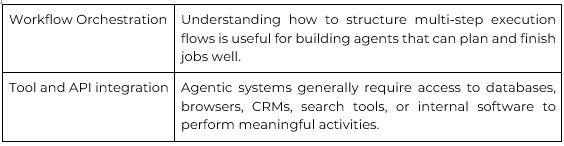
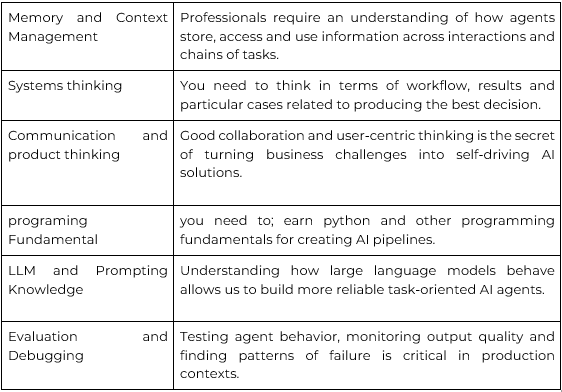
Learn these skills easily by joining an Agentic AI Training in Chennai. This city is called the hub of the IT sector and you get multiple job opportunities over there.
Path to Learn Agentic AI:
1. Learn about AI and LLM Basics
Begin with the fundamentals of machine learning, generative AI, and prompt engineering. Before you start building more sophisticated autonomous systems first learn how Large Language Models read text and generate responses.
2. Develop Strong Programming Skills
Learn Python, interact with REST APIs, learn scripting. With strong programming skills you may connect AI models to external data sources, establish logical decision-making workflows and build fully working software applications from the start.
3. Understanding Agent Architectures
How to make AI bots run themselves. Learn how they break down big goals into small tasks, use short and long-term memory, look up information outside, and apply what’s going on right now to answer hard questions with no human help.
4.Train Using Real Tools
Familiarity with commonly used agent frameworks and APIs. Build simple projects like automated research assistants, personal planning bots, or task managers to learn how agents work and how they interact with software tools.
5. Projects and Use Cases Development
Concentrate on establishing helpful tools such as automated customer service managers, document analyzers or workflow automation bots that provide genuine value.
6. Evaluate and learn reliability
Learn how to evaluate your agent’s performance and the quality of its output. Learn how to remove hallucinated answers, fix bugs in workflows, and ensure your autonomous systems work in predictable and safe ways in the real world.
7. Research Domain
Select the domain you want to work for and specialize your skills for that particular industry. It increases your value of skills.
8. Create Your Portfolio
Create your portfolio to show your work and get a high paying job.
Job Opportunities After Studying Agentic AI
The rise of workplace automation for autonomous operations opens up a wide range of career options across many fields with a career in agentic AI. Salaries are rising year-on-year, from ₹6 LPA for Agentic AI Engineers, ₹10.4 LPA for the Machine Learning Engineers, ₹20.5 LPA for LLM Engineers, ₹25 LPA for AI Product Managers to ₹34 LPA for senior AI Architects.
The demand for professionals is very high in Bangalore. If you are living there and want to enhance your AI skills then join the Agentic AI Course in Bangalore.Sum up
The agentic artificial intelligence career path is one of the most promising options for professionals interested in working on the creation of intelligent systems in the future. As companies continue to shift more and more toward autonomous artificial intelligence capabilities, there will be a continued growth in demand for qualified personnel who can build, run and direct these systems. So, if you focus on the right skills, tools, and hands-on projects, you may build a strong foundation for a future-ready job in artificial intelligence.