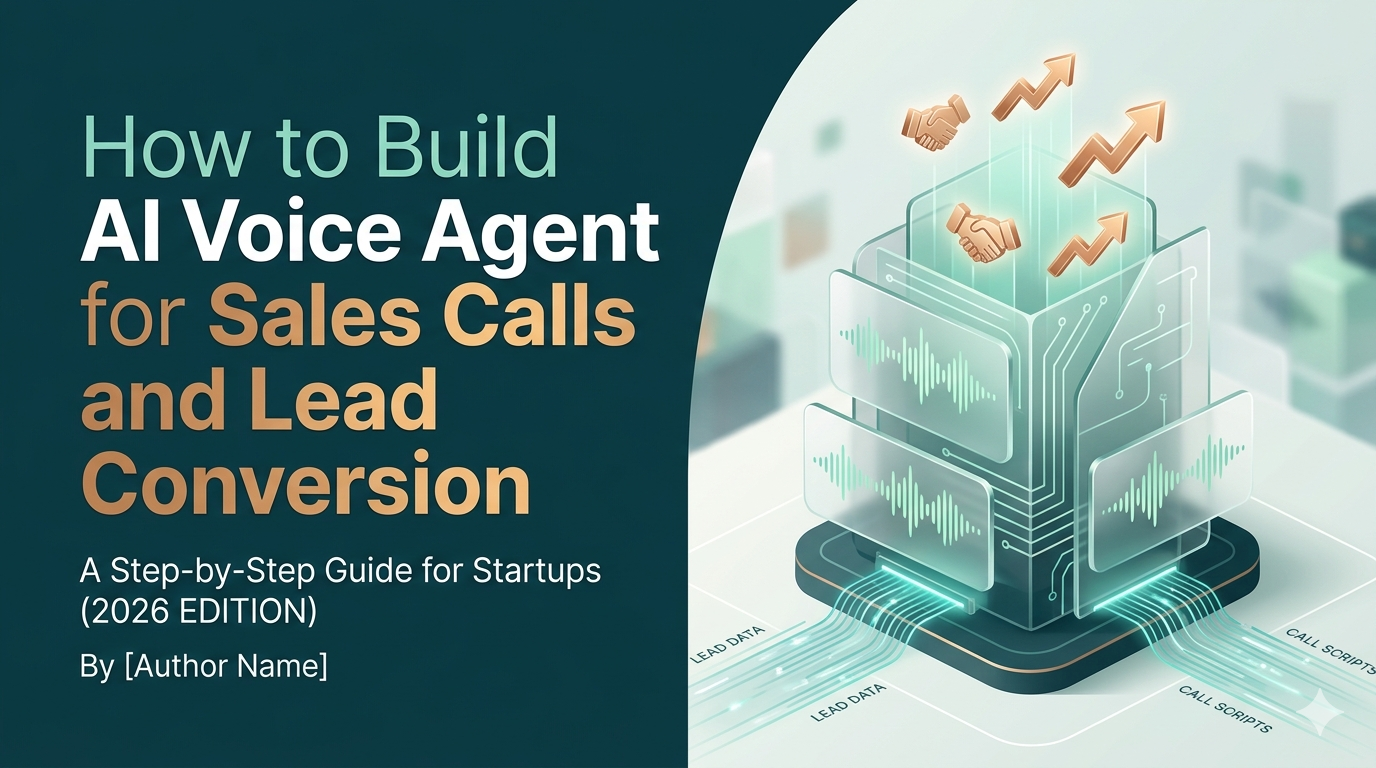
How to Build AI Voice Agent for Sales Calls and Lead Conversion
Do not use any horizontal lines or dash rows between sections.
In today’s fast growing digital economy, every AI Company is looking for smarter ways to automate sales and improve lead conversion. Businesses are no longer relying only on human sales teams because AI voice agents can handle thousands of conversations at scale with consistency and speed. Whether you run a startup or a Best AI Company, building an AI voice agent for sales calls can transform how you capture leads, nurture prospects, and close deals. This guide explains step by step how to build an AI voice agent that sounds natural, understands customer intent, and converts conversations into revenue.
What is an AI Voice Agent for Sales
An AI voice agent is a software system that uses speech recognition, natural language processing, and text to speech technology to interact with users over voice calls. It can answer questions, qualify leads, pitch products, and even schedule meetings without human intervention.
Unlike traditional IVR systems, modern AI voice agents understand context, emotions, and intent. This allows them to deliver human like conversations that feel natural and engaging.
Why AI Voice Agents are Powerful for Sales
AI voice agents are changing the sales process in several ways:
- 24 by 7 Availability
Your sales process never stops. The agent can handle calls anytime without delays.
- Faster Lead Qualification
It quickly identifies high quality leads based on predefined criteria.
- Cost Efficiency
You reduce dependency on large sales teams while maintaining performance.
- Consistent Messaging
Every prospect hears the same optimized pitch which improves conversions.
- Scalability
Handle thousands of calls simultaneously without performance issues.
Core Components of an AI Voice Agent
To build a high performing AI voice agent, you need to understand its core components.
Speech Recognition
This converts user voice into text. Tools like Whisper or Google Speech API are commonly used.
Natural Language Processing
This helps the system understand user intent, context, and meaning.
Dialogue Management
This decides how the agent responds based on conversation flow.
Text to Speech
This converts responses into natural sounding voice output.
CRM Integration
Connect your agent with CRM tools to store and manage lead data.
Step by Step Guide to Build AI Voice Agent
Step 1. Define Your Sales Goal
Start with a clear objective. Ask yourself:
Are you generating leads
Are you qualifying prospects
Are you closing sales
Are you booking appointments
Your goal will define the conversation flow and AI logic.
Step 2. Design Conversation Flow
Create a structured script that includes:
Greeting message
Qualification questions
Product pitch
Handling objections
Call to action
Keep it natural and conversational. Avoid robotic responses.
Step 3. Choose the Right Tech Stack
You can build your AI voice agent using:
Speech recognition APIs
Natural language models like GPT
Voice synthesis tools
Cloud platforms like AWS or Google Cloud
Select tools based on scalability and budget.
Step 4. Train Your AI Model
Feed your system with:
Sales scripts
Customer queries
Objection handling scenarios
Industry specific conversations
The more data you provide, the smarter your AI becomes.
Step 5. Integrate with Calling System
Use VoIP or telephony APIs like Twilio to enable real time calls. This allows your AI agent to:
Make outbound calls
Receive inbound calls
Record conversations
Track performance
Step 6. Connect CRM and Analytics
Integrate tools like HubSpot or Salesforce to:
Store lead data
Track conversions
Analyze performance
Improve targeting
Step 7. Test and Optimize
Before launching, test your AI agent thoroughly:
Check voice clarity
Test conversation flow
Handle edge cases
Analyze user responses
Continuous optimization is key to success.
Best Practices for High Lead Conversion
Personalization
Use customer data to personalize conversations. Address users by name and reference their needs.
Human Like Tone
Avoid robotic speech. Use natural pauses and conversational language.
Smart Objection Handling
Train your AI to handle objections like pricing, trust, and urgency effectively.
Clear Call to Action
Always guide the user towards the next step such as booking a call or making a purchase.
Data Driven Improvement
Use analytics to improve scripts and conversation flows over time.
Common Challenges and Solutions
Challenge 1. Robotic Conversations
Solution: Use advanced NLP models and better training data.
Challenge 2. Misunderstanding User Intent
Solution: Improve intent recognition and add fallback responses.
Challenge 3. Integration Issues
Solution: Use reliable APIs and scalable infrastructure.
Challenge 4. Low Conversion Rates
Solution: Optimize scripts and personalize interactions.
Use Cases of AI Voice Agents in Sales
Lead Generation
Automatically call potential customers and collect information.
Appointment Booking
Schedule meetings without human involvement.
Customer Follow Ups
Reconnect with leads and nurture relationships.
Product Promotion
Explain features and benefits to prospects.
Feedback Collection
Gather insights from customers after interaction.
Future of AI Voice Agents in Sales
AI voice technology is evolving rapidly. Future trends include:
Emotion detection for better engagement
Multilingual support for global reach
Real time personalization using data
Deeper CRM integration
Autonomous decision making
Businesses that adopt this early will gain a strong competitive advantage.
How an AI Company Can Benefit from Voice Agents
Any AI Company can leverage voice agents to scale operations and improve ROI. By automating repetitive sales tasks, companies can focus on strategy and innovation.
A Best AI Company uses voice AI not just for automation but for creating intelligent customer experiences that drive growth and long term engagement.
Final Thoughts
Building an AI voice agent for sales calls and lead conversion is no longer a luxury, it is becoming a necessity. With the right strategy, tools, and optimization, you can create a powerful system that boosts efficiency and revenue.
Start with a clear goal, build a strong foundation, and continuously improve based on data. As AI technology advances, voice agents will play a central role in shaping the future of sales.
If you implement this correctly, your business will not just generate leads, it will convert them faster and smarter than ever before.