
Business Bankruptcy Risk Assessment
-
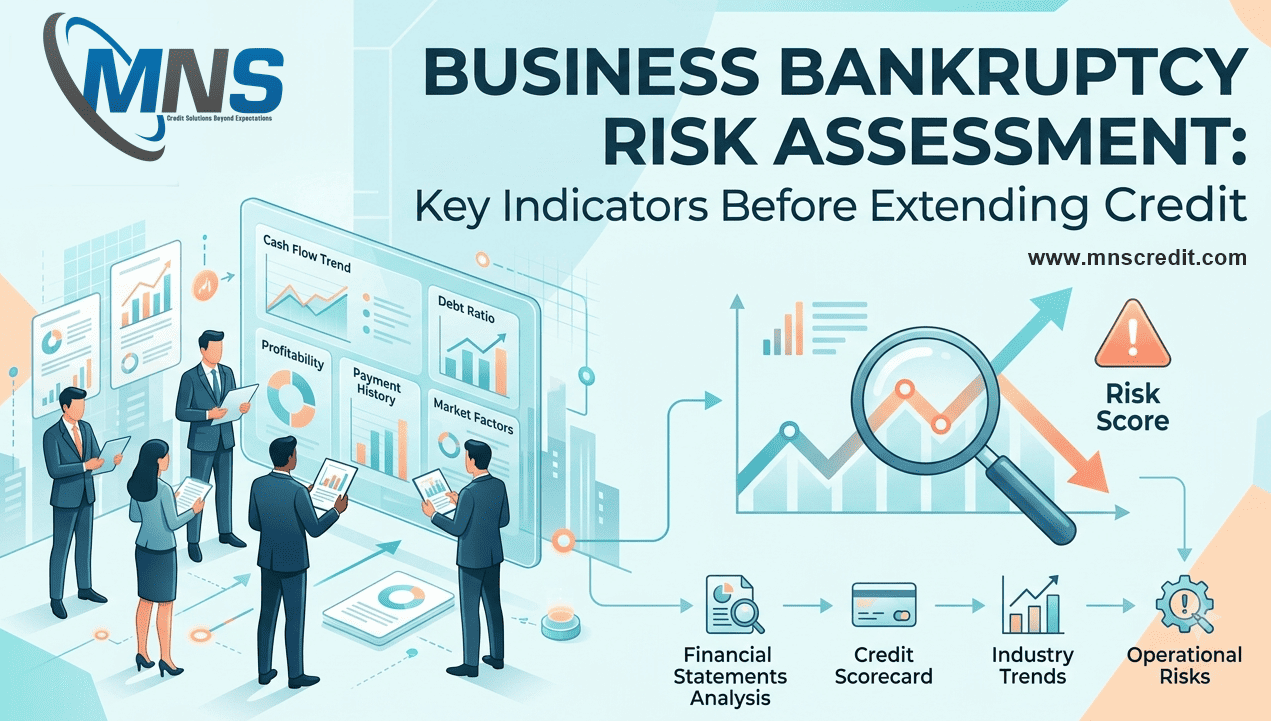
Extending credit to a new customer, distributor, or borrower is, at its core, a bet on that entity's continued solvency over the life of the receivable. Get the assessment wrong, and a single default can wipe out the margin earned on dozens of smaller, well-performing accounts. Yet many businesses still approve credit limits based on a cursory look at turnover figures or a verbal assurance from a sales team eager to close the deal. A structured bankruptcy risk assessment, applied consistently before credit is extended, is what separates businesses that manage bad debt as a controlled cost from those that are repeatedly surprised by it.This article sets out the key financial, non-financial, and behavioral indicators that should form part of any pre-credit risk assessment, along with guidance on translating that assessment into a workable credit decision.
- Financial Indicators That Matter Most
Financial statements remain the foundation of any credit decision, but the ratios that matter for bankruptcy prediction are narrower than the full set typically reviewed in equity analysis.
- Liquidity ratios: the current ratio and quick ratio indicate whether a business can meet its near-term obligations from liquid assets. Ratios trending downward across two or more years are more informative than a single snapshot.
- Leverage and debt-equity position: high leverage relative to industry norms reduces a company's ability to absorb a revenue shock, and increases the odds that lenders, not trade creditors, get paid first in a downturn.
- Interest coverage ratio: a business whose operating earnings barely cover its interest obligations has little room to withstand a bad quarter, let alone a bad year.
- Operating cash flow trends: profitable-looking businesses can still be cash-negative if working capital is poorly managed; consistent negative operating cash flow despite reported profit is a strong warning sign.
- Altman Z-Score and similar predictive models: composite bankruptcy-prediction scores combining profitability, leverage, liquidity, and efficiency ratios provide a useful, standardized starting point for comparing risk across counterparties.
- Non-Financial Indicators
Financial statements are historical by nature and can lag real-time conditions by months. Non-financial indicators help fill that gap.
- Management track record: prior business failures, frequent changes in registered office, or a history of related entities being struck off should be treated as material to the credit decision.
- Industry and sector outlook: businesses operating in sectors facing structural decline, regulatory disruption, or cyclical downturns carry elevated baseline risk regardless of their individual financial position.
- Promoter and related-party structure: complex webs of related entities can be used to shift assets away from a struggling operating company, making recovery harder even where the group as a whole has value.
- Litigation and dispute history: an unusually high volume of ongoing legal disputes, particularly recovery suits filed by other creditors, is a direct signal of existing repayment stress.
- Regulatory and compliance standing: MCA filing history, GST return regularity, and statutory compliance status offer an objective, hard-to-fabricate picture of how well a business is being run.
-
Trade References and Payment Behavior
Few sources are as directly predictive of future payment behavior as a counterparty's existing payment history with other suppliers. Structured trade reference checks — contacting two or three existing suppliers to confirm payment terms actually honored versus terms agreed — often surface issues that never appear in financial statements. A pattern of requesting extended terms, frequent part-payments, or disputes over invoices with multiple suppliers is a strong indicator that credit exposure should be limited, secured, or declined altogether. -
Building a Risk-Tiered Credit Decision
- Once financial, non-financial, and behavioral indicators have been gathered, the goal is to translate them into a defensible credit decision rather than a binary approve-or-decline outcome.
- Risk tiering: segmenting counterparties into low, medium, and high-risk tiers allows credit limits, payment terms, and monitoring frequency to be calibrated proportionally rather than applying a single policy to every account.
- Security and structuring options: higher-risk accounts can still be serviced through structured arrangements — bank guarantees, letters of credit, personal guarantees from promoters, or credit insurance — rather than outright decline.
- Setting realistic credit limits: limits should be set as a function of the counterparty's demonstrated capacity to pay, not simply the size of the deal on the table.
- Documenting the rationale: recording why a particular limit and term structure was approved protects the business if a dispute or recovery action follows later.
-
Why a One-Time Check Is Not Enough
A risk assessment conducted only at the point of onboarding has a shelf life. Financial positions, litigation exposure, and compliance status can change meaningfully within a single year. Businesses that rely solely on an initial credit check often discover deterioration only when a payment is already overdue, by which point options for reducing exposure are limited. Embedding periodic re-assessment — particularly for larger or longer-tenured accounts — into the credit management process closes this gap.
Structured, independently verified credit assessment reports combine financial ratio analysis, compliance data, and litigation checks into a single risk view, giving credit teams a consistent basis for approval decisions rather than relying on self-reported figures from the counterparty itself. -
Aligning Risk Assessment With Business Strategy
It is worth remembering that the objective of bankruptcy risk assessment is not to eliminate risk altogether — a credit policy that only accepts zero-risk counterparties would also reject a large share of legitimate, growing customers. The objective is to price and structure risk appropriately: extending generous terms to genuinely low-risk accounts to support growth, while ensuring higher-risk accounts are secured, limited, or monitored closely enough that a default does not become a surprise. This balance is what allows a credit function to support commercial growth without becoming the source of the next bad-debt write-off.
For businesses without an internal credit analysis team, or those extending credit into new sectors or geographies, outsourcing this assessment to specialists with access to registrar, litigation, and financial databases is often more reliable — and considerably faster — than building the capability from scratch.
MNS Credit Management Group's business verification and due diligence services are built specifically to support credit decisions of this kind, giving businesses an independent, evidence-based view of counterparty risk before credit terms are finalized. -
Common Mistakes That Undermine Risk Assessment
- Relying solely on self-submitted documents: financial statements and references provided directly by the applicant should always be independently verified against registrar filings and third-party sources, since self-reported figures can be dated, incomplete, or presented selectively.
- Treating turnover as a proxy for creditworthiness: a high-revenue business with thin margins and heavy leverage can be riskier than a smaller, well-capitalized one; assessment should weigh the full financial picture rather than a single headline figure.
- Skipping re-assessment for long-standing accounts: risk assessment is too often applied only at onboarding and never revisited, even as a counterparty's financial position changes materially over subsequent years.
- Underestimating sector-wide risk: individually sound counterparties in a structurally declining or highly cyclical sector still carry elevated portfolio-level risk that should factor into overall credit exposure limits.
- Avoiding these mistakes is often less about acquiring new data and more about applying the data already available with greater discipline and consistency across every credit decision, regardless of deal size or the urgency of the sales team pushing it through.
- Financial Indicators That Matter Most