
Why QuickBooks Hosting Is Better Than Managing Your Own Server
-
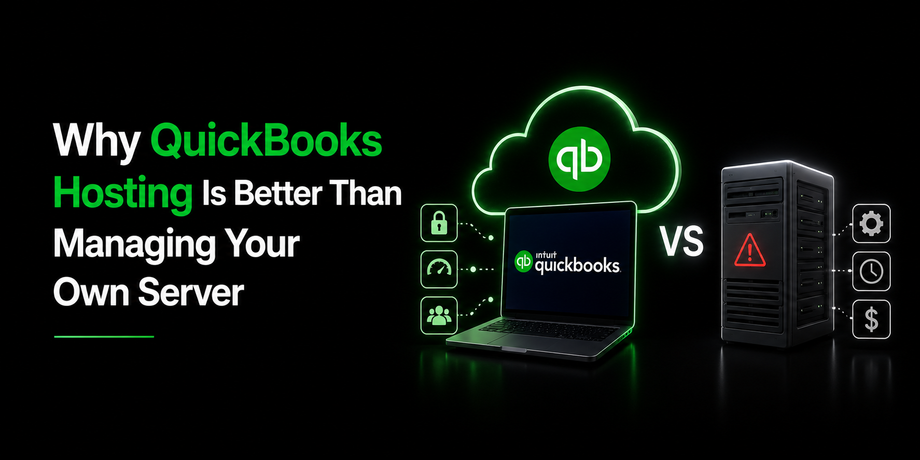
Running QuickBooks on an in-house server used to be the default choice for small and mid-sized businesses. But as teams grow, go remote, and demand faster access to financial data, self-managed servers are starting to show their limits. This is where QuickBooks hosting comes in - a solution that takes the technical burden off your plate while giving your team secure, anytime access to your accounting data.
In today’s competitive business environment, downtime or slow access to accounting systems can directly impact decision-making, payroll processing, and client servicing. Businesses now expect real-time access, stronger security, and reduced IT dependency. Traditional servers often struggle to meet these expectations consistently, especially without dedicated IT infrastructure or 24/7 monitoring support.
In this article, we'll break down why more businesses are switching from self-hosted servers to QuickBooks hosting, and what that shift actually means for cost, security, and day-to-day productivity.
1. Lower Total Cost of Ownership
Managing your own server isn't just about the upfront hardware cost. It includes:
- Server purchase and periodic upgrades
- Licensing for operating systems and backup software
- Electricity, cooling, and physical space
- IT staff or contractors to maintain uptime
These costs often increase over time, especially when hardware becomes outdated or unexpected failures occur. Businesses also underestimate indirect costs such as downtime losses and productivity delays when systems are down.
With QuickBooks hosting, all of this shifts to a predictable monthly subscription. The hosting provider owns the infrastructure, maintenance, and upgrades, so you avoid large capital expenses and unplanned repair costs. This financial predictability helps businesses plan budgets more effectively and redirect savings toward growth, hiring, or technology improvements rather than server maintenance.
2. Better Uptime and Reliability
An in-house server depends on your local power supply, internet connection, and hardware health. A single power outage or hard drive failure can take your accounting system offline for hours — sometimes days. Even minor hardware issues can lead to major disruptions if backups are not properly configured or tested.
Hosting providers run QuickBooks on enterprise-grade data centers with redundant power, backup internet connections, and 24/7 monitoring. This translates to significantly higher uptime than most businesses can achieve on their own. These environments are designed with multiple failover systems, ensuring uninterrupted access even during unexpected failures or maintenance events.
As a result, businesses experience fewer interruptions, improved workflow continuity, and more dependable access to financial data when it matters most.
3. Stronger Security and Compliance
Self-managed servers require you to independently handle firewalls, antivirus updates, intrusion detection, and patch management. Most small businesses simply don't have the dedicated security staff to do this consistently, which can leave systems exposed to evolving cyber threats.
QuickBooks hosting providers typically include:- Multi-factor authentication
- Data encryption in transit and at rest
- Regular automated backups
- Compliance-ready infrastructure (SOC, HIPAA-aligned, etc., depending on provider)
In addition, many providers conduct routine vulnerability assessments and security audits to maintain high standards. This proactive approach helps prevent breaches before they occur, rather than reacting after damage is done.
This level of protection is difficult and expensive to replicate on a self-owned server, especially for growing businesses without dedicated cybersecurity teams.
4. Remote Access From Anywhere
One of the biggest advantages of QuickBooks hosting is accessibility. Your team — whether in the office, at home, or traveling — can log into the same QuickBooks environment from any device with an internet connection. This flexibility is especially important in hybrid and remote work environments, where employees need real-time access to financial data without location restrictions.
Self-hosted servers, on the other hand, usually require VPNs or remote desktop setups that are clunky, slower, and harder to secure. These systems often introduce connection issues, performance lag, and additional maintenance requirements.
With QuickBooks hosting, users experience a smoother login process, consistent performance, and unified access to data, making collaboration easier and more efficient across distributed teams.
5. Simplified IT Management
When something goes wrong with a self-managed server, the responsibility falls entirely on your internal team. This includes troubleshooting crashes, applying patches, monitoring performance, and handling emergency repairs — often outside working hours.
With hosting, troubleshooting, patching, and maintenance are handled by the provider's support team, freeing your staff to focus on actual business tasks instead of server upkeep. Providers also monitor systems proactively, identifying potential issues before they escalate into downtime.
This reduces pressure on internal IT teams and eliminates the need for specialized server management expertise in-house. As a result, businesses can operate more efficiently without being slowed down by technical maintenance responsibilities.
6. Easier Scalability
Growing businesses often outgrow their existing server hardware, forcing costly upgrades or replacements. Planning for future capacity can be difficult, and over-provisioning often leads to wasted resources and higher costs.
Hosted environments scale on demand — need more users, more storage, or more processing power? It's usually a quick plan change rather than a hardware overhaul. This flexibility allows businesses to respond quickly to growth or seasonal workload spikes.
Additionally, scaling down during slower periods is also possible, helping optimize costs. This level of agility is rarely achievable with traditional in-house servers, making QuickBooks hosting a more future-ready solution for modern businesses.
Making the Switch
Moving from a self-managed server to a hosted environment doesn't have to be disruptive. Most providers offer migration assistance, and businesses typically notice improvements in speed, accessibility, and peace of mind within the first few weeks.
The transition usually involves minimal downtime when handled by experienced providers. Data migration, configuration, and user setup are carefully managed to ensure continuity. Training and onboarding support are often included as well, helping teams adapt quickly to the new environment.
Once the switch is complete, businesses often report improved collaboration, fewer technical issues, and a more stable accounting workflow overall.
Conclusion
While managing your own server may feel like it offers more control, the reality is that it often comes with higher costs, more downtime risk, and a heavier IT burden than most businesses are equipped to handle. QuickBooks hosting removes these pain points by offering reliable uptime, enterprise-grade security, and remote accessibility — all without the overhead of owning physical infrastructure.
For businesses looking to make this transition smoothly, Apps4Rent offers professional QuickBooks hosting solutions backed by secure data centers, responsive support, and flexible plans tailored to businesses of all sizes. Instead of worrying about server maintenance, you can focus on running your business while Apps4Rent handles the technical heavy lifting.
Ready to Simplify Your Accounting Infrastructure?Stop spending time and money maintaining your own server. Switch to a hosted QuickBooks environment and get secure, anytime access to your financial data. Contact Apps4Rent today to get started with a QuickBooks hosting plan built around your business needs.
Frequently Asked Questions
1. What is QuickBooks hosting?
It's a service where QuickBooks is run on a remote, provider-managed server, letting users access it securely over the internet instead of a local machine.
2. Is QuickBooks hosting secure?
Yes. Reputable providers use encryption, multi-factor authentication, and regular backups to protect your financial data.
3. Can multiple users access QuickBooks hosting at the same time?
Yes, most hosting plans support multi-user access, allowing teams to work simultaneously from different locations.
4. Is QuickBooks hosting expensive compared to a self-managed server?
Generally, no. Hosting is typically a predictable monthly cost, avoiding large upfront hardware and IT maintenance expenses.
5. How do I migrate to QuickBooks hosting?
Most providers, including Apps4Rent, offer guided migration support to move your existing QuickBooks data with minimal downtime.