How AR and AI Are Transforming Security Operations — And What That Means for Personnel Vetting
-
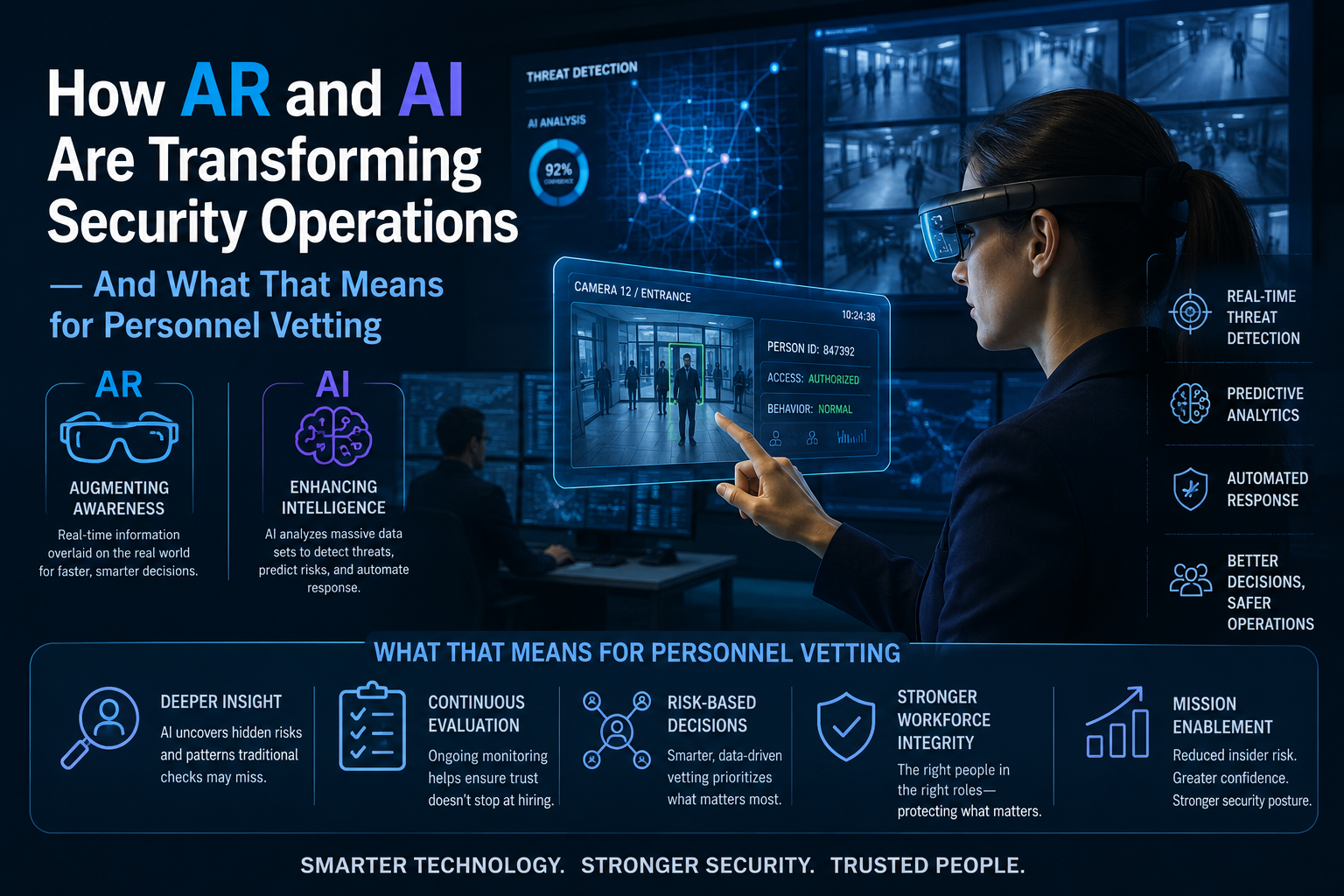
The intersection of augmented reality and artificial intelligence is reshaping how security and defense organisations operate on the ground. Real-time data overlaid on an officer's field of view, AI-assisted decision support that processes contextual information faster than any human can, wearable hardware that gives responders access to situational intelligence without looking away from the environment they are operating in — these are not science fiction anymore. They are operational realities at a growing number of law enforcement agencies, military units, and enterprise security operations.
But the technology that enables smarter, faster, more informed operations in the field also creates a new set of questions about who has access to it — and how organisations should think about the vetting of the personnel operating these systems.
What AR and AI Are Doing for Law Enforcement Operations
The specific applications of AR in law enforcement and security operations are expanding as the hardware has become more capable and the software has matured. The use cases that have moved from proof-of-concept to operational deployment represent a meaningful shift in how officers access and act on information.
Real-time facial recognition overlaid in an officer's field of view through smart glasses allows rapid identification of individuals against law enforcement databases — without the officer having to look away from the environment, reach for a radio, or wait for dispatch to run a query. The identification happens in real time, in the officer's field of view, with results displayed through the heads-up interface of the AR glasses.Suspect and warrant information retrieval works similarly — an officer conducting a stop can see relevant information about the vehicle, registered owner, and any active warrants overlaid in their field of vision rather than queued to their in-car terminal. The practical effect is that officers are better informed earlier in an interaction, which supports better decision-making.
For command and control environments — where commanders need situational awareness across multiple units operating in different locations — AR-powered command centers integrate real-time field data, GPS positioning, and environmental intelligence into a unified operational picture. The commander who previously synthesised this from multiple screens and radio traffic can now see it in a coordinated, spatially-aware interface that significantly reduces cognitive load.
The Security Clearance and Background Vetting Context
The systems described above operate in security-sensitive environments and handle information that is either classified, law enforcement-sensitive, or otherwise restricted. The people who operate them — the law enforcement officers wearing AR glasses, the defense personnel accessing classified AR workflows, the security contractors managing enterprise AR installations — must be vetted to a standard appropriate to the access level involved.
This vetting context makes personnel background screening a directly relevant operational consideration for any organisation deploying AR and AI in security-sensitive environments. The hardware vendor, the software developer, and the organisation deploying the system all have a stake in ensuring that the people with hands-on access to these systems and the information they display are appropriately cleared.
For law enforcement agencies specifically, Level 2 screening — the enhanced background check that goes beyond standard criminal record searches to include comprehensive fingerprint-based FBI checks, professional license verification, and in some cases psychological assessment — is increasingly required for officers and civilian personnel who access sensitive systems. Level 2 checks are mandatory in many jurisdictions for law enforcement personnel and for civilian contractors working within law enforcement facilities. Organisations deploying AR systems in these environments should verify that their personnel screening standards meet the requirements for the specific roles involved.
The AI component of these systems adds a further dimension to the vetting consideration. AI systems that process biometric data, that inform law enforcement decision-making, or that manage access to classified information require that their operators and administrators are vetted not just for general trustworthiness but for their specific understanding of the security requirements governing the data the system handles.
How AR Is Changing the Speed of Criminal History Checks
One of the more direct intersections between AR technology and background verification is in the operational context of law enforcement checks conducted in the field. The officer who encounters a subject during a stop, a traffic check, or a patrol interaction has historically needed to radio dispatch or access a vehicle terminal to run a check against criminal databases. AR-enabled smart glasses are changing this workflow — the check can be initiated and results received in the officer's heads-up display without breaking their attention from the field situation.
This acceleration of field-based criminal history checks has operational implications that extend beyond convenience. The speed at which an officer can confirm whether a subject has an active warrant, outstanding charges, or a relevant criminal history affects the officer's ability to manage the interaction safely and appropriately. An officer who knows within seconds that a subject has a history of violent offenses is better positioned to calibrate their response than one who is waiting for a radio callback.
The same AR-based workflow is applicable to employment-adjacent contexts — security contractors running real-time checks during access control situations, venue security personnel verifying credentials at high-security events, or background verification operators using AR-assisted interfaces to process arrest records checks and criminal history verifications more efficiently. The technology layer that makes field operations faster for law enforcement can also make background verification workflows faster for any security-sensitive employment or access context.
The Enterprise Side: AR for Industrial Security and Personnel Management
Beyond defense and law enforcement, ThirdEye's enterprise applications in manufacturing, aerospace, and field service create their own personnel vetting considerations. The industrial worker equipped with AR smart glasses that provide real-time assembly guidance, safety overlays, and remote expert support is operating in an environment where the technology's value is entirely dependent on the worker's actual competency and trustworthiness.
In manufacturing environments where AR-guided assembly is used for complex or safety-critical components, the personnel operating these systems must be verified to have the qualifications and training they claim. An aerospace manufacturer deploying AR guidance for aircraft component assembly has a direct safety obligation to verify that the technicians following AR guidance have the underlying skills to recognise when the AR system is giving incorrect guidance — which requires genuine qualification, not just claimed qualification.
The AI-driven growth that AR and AI technology companies like ThirdEye are achieving is substantially powered by demonstrating real, measurable ROI in enterprise deployments — the reduction in error rates, the acceleration of training timelines, the improvement in remote collaboration efficiency. These ROI claims are most credible when they are anchored in deployments where the personnel variables have been controlled — where the people using the AR systems are genuinely qualified, genuinely vetted, and operating in genuinely appropriate roles.
The Training and Certification Layer That Completes the System
AR and AI technology changes what is possible in field operations, security contexts, and industrial environments. But the technology's value is bounded by the capability and trustworthiness of the people operating it. The smart glasses that provide a law enforcement officer with real-time identification capability are only as valuable as the officer's judgment in acting on what they see. The AR-guided manufacturing workflow is only as safe as the technician following the guidance.
This is why the personnel infrastructure that surrounds AR deployment — the training, the certification, and the background vetting — is not peripheral to the technology's value proposition but central to it. Organisations that deploy advanced AR and AI systems without adequately addressing the personnel layer are building on an unstable foundation: the technology's capability will eventually surface failures in the personnel layer in ways that are operationally consequential and, in security or safety-critical environments, potentially dangerous.
The organisations that get this right treat the technology deployment and the personnel infrastructure as a unified programme rather than sequential projects. The AR system design and the personnel training programme are developed in parallel. The background screening standards for AR system operators are defined at the same time as the system access controls. The ongoing monitoring of personnel clearance status is built into the system access management workflow rather than handled as a separate HR process.
This integrated approach — technology and people designed together rather than technology first and people as an afterthought — is what produces the operational outcomes that AR and AI technology promises. And it is the approach that the most sophisticated defense, law enforcement, and enterprise organisations are increasingly recognising as the only viable model for deploying these systems at the scale and in the contexts where they genuinely matter.
-
The combination of AR and AI in security-sensitive environments requires more than capable hardware; it also depends on reliable software, secure data handling, and well-designed user interfaces. Systems that process real-time information need to be developed with strong attention to privacy, access controls, accuracy, and usability. Thorough testing is especially important when technology is being used to support decisions in law enforcement, defense, or industrial settings.
The development team behind these platforms also plays an important role in ensuring that the technology is scalable and secure. Experienced Software Developers in NewYork can contribute to building AR interfaces, AI integrations, backend systems, and secure APIs while keeping performance and data protection in mind. A strong development team can help turn complex AR and AI capabilities into practical systems that are reliable for real-world operational environments.
-
The PK 67 game’s secret lies in how it blends automation with player strategy—just like how defense systems integrate tech with human insight. Grinding for resources isn’t just about luck; it’s about optimizing your PK 67 game play online loops to unlock hidden progression paths, much like scaling AI deployments for real-world impact.