
Generative AI in FinTech: 7 Use Cases Reshaping Financial Service
-
Generative AI in FinTech: 7 Use Cases Reshaping Financial Services
What Is Generative AI in FinTech?
Generative AI is becoming an important technology across banking, payments, lending, insurance, wealth management, and other financial services. Unlike traditional AI systems designed mainly to classify data or predict outcomes, generative AI produces new content such as text, summaries, reports, recommendations, and responses.
Financial institutions handle huge amounts of customer information, transaction records, contracts, financial reports, regulations, and internal documentation. Generative AI helps employees process this information faster and interact with it using natural language.
The technology is also moving beyond basic chatbots. Financial organizations are exploring AI-powered assistants, document intelligence, personalized customer experiences, compliance support, and intelligent workflow automation.
Why Generative AI Matters for Financial Services
Financial services companies operate in a data-intensive environment. Employees spend significant time reviewing documents, answering customer queries, preparing reports, analyzing information, and maintaining compliance processes.
Generative AI provides opportunities to reduce manual effort while improving the speed of information processing.
According to Deloitte's 2025 research on generative AI in financial services, 46% of surveyed financial services organizations were classified as generative AI pioneers based on their level of expertise and adoption.
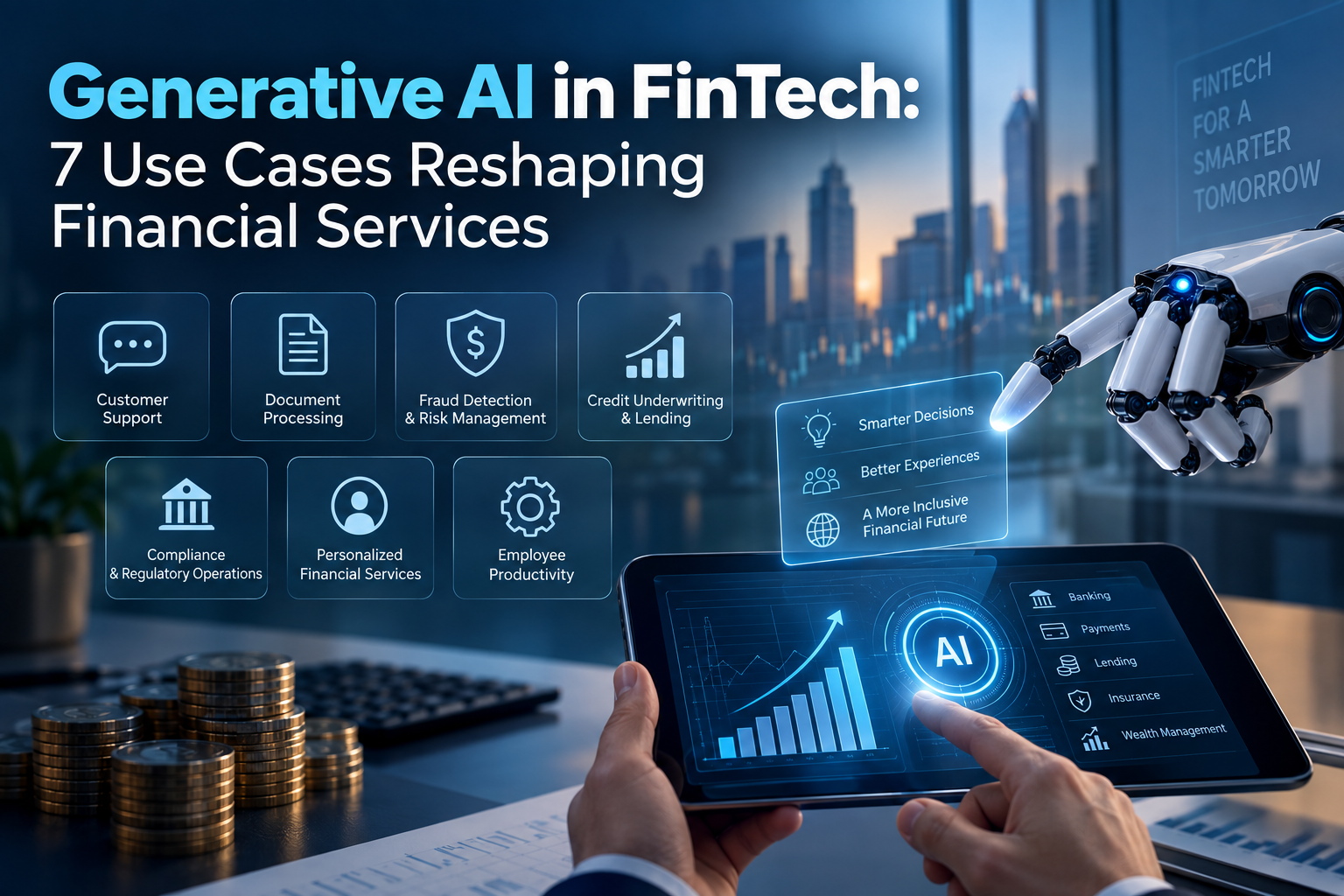
Several areas are driving interest:
- Customer service automation
- Financial document processing
- Fraud and risk analysis
- Compliance operations
- Credit and lending support
- Personalized financial services
- Employee productivity
A well-planned Generative AI in FinTech strategy focuses on these business processes and connects AI capabilities with measurable operational goals.
7 Major Use Cases of Generative AI in FinTech
1. AI-Powered Customer Support
Customer service is one of the most visible applications of generative AI in financial services.
AI assistants help answer questions about accounts, payments, transactions, products, fees, and financial services. They provide support around the clock and reduce the workload for human agents.
The major advantage comes from handling repetitive requests automatically while routing complex or sensitive cases to employees.
Financial institutions also use AI to summarize customer interactions, recommend responses, and help service teams retrieve information quickly.
2. Financial Document Processing
Banks, insurers, and FinTech companies process large volumes of documents every day.
These include:
- Loan applications
- Contracts
- Invoices
- Financial statements
- Customer forms
- Regulatory documents
- Insurance records
Generative AI can summarize long documents, extract key information, compare documents, and organize unstructured content.
This reduces manual review time and gives employees faster access to important information.
Document processing is also becoming an important part of Generative AI in FinTech, especially when organizations combine language models with document intelligence and retrieval systems.
3. Fraud Detection and Risk Management
Fraud detection traditionally depends on rules, statistical models, and machine learning systems. Generative AI adds another layer by helping investigators understand large amounts of information and create explanations around suspicious activity.
For example, an AI system can summarize transaction histories, identify relevant patterns, and prepare an investigation report for an analyst.
It can also help fraud teams analyze customer communications and supporting documents alongside transaction information.
Generative AI does not replace established fraud detection models. It works best as an intelligence layer that supports analysts and improves investigation workflows.
4. Credit Underwriting and Lending
Loan underwriting involves reviewing income records, financial statements, credit information, applications, and supporting documents.
Generative AI can extract information from these sources and prepare structured summaries for underwriting teams.
For example, an AI system might organize borrower information into areas such as income, liabilities, repayment history, and financial risk indicators.
This improves analyst productivity and reduces the time spent reviewing repetitive documentation.
Human review remains critical for lending decisions. AI should support the process rather than operate without appropriate oversight.
5. Compliance and Regulatory Operations
Financial institutions operate under strict regulatory requirements. Compliance teams constantly review regulations, internal policies, risk controls, and reporting requirements.
Generative AI can support these teams by summarizing regulations, comparing policy documents, finding relevant information, and preparing draft reports.
Compliance teams can also use AI-powered knowledge systems to answer internal questions based on approved organizational information.
This makes compliance workflows faster while preserving review and approval processes.
6. Personalized Financial Services
Customers increasingly expect financial products and communications to reflect their individual needs.
Generative AI helps financial institutions produce personalized explanations, recommendations, financial education content, and customer communications.
For example, an AI assistant could explain spending patterns in simple language or provide personalized information about savings options based on predefined business rules.
Personalization also helps organizations improve product discovery and customer engagement.
7. Employee Knowledge and Productivity
Employees often spend large amounts of time searching for policies, product documentation, procedures, research, and internal information.
Generative AI provides a natural-language interface for accessing this knowledge.
A retrieval-augmented generation system, often called RAG, connects an AI model with approved enterprise data. Employees ask questions in natural language and receive responses grounded in relevant internal sources.
This application is valuable for customer support teams, compliance departments, underwriters, financial analysts, and operations teams.
Benefits of Generative AI for Financial Institutions
The benefits of Generative AI in FinTech extend beyond simple automation.
Financial institutions can improve:
- Customer response times
- Employee productivity
- Document processing speed
- Operational efficiency
- Access to internal knowledge
- Financial research workflows
- Compliance operations
- Customer personalization
Organizations should measure these benefits using specific business metrics rather than focusing only on AI adoption.
Useful KPIs include average handling time, processing time, cost per transaction, fraud investigation time, response time, and employee productivity.
A financial institution that reduces document processing from several hours to a few minutes has a more meaningful AI result than one that measures success only by the number of AI interactions.
Challenges and Risks
Financial services require stronger controls than many other industries because AI systems often work with sensitive customer and financial information.
One major issue is accuracy. Generative AI systems sometimes produce incorrect information or unsupported answers. This creates additional risk when an AI system operates in financial or regulatory workflows.
Data privacy is another critical concern. Financial institutions must control access to customer information and ensure sensitive data is handled securely.
Other challenges include:
- Model governance
- Data quality
- Cybersecurity
- Third-party dependencies
- Bias and fairness
- Explainability
- Regulatory compliance
- Human oversight
These risks make governance a core part of Generative AI in FinTech, rather than something added after deployment.
How to Implement Generative AI Successfully
Financial institutions should start with a specific business problem.
Instead of deploying a general-purpose AI assistant across the organization, companies should begin with a focused workflow such as document processing, employee knowledge retrieval, or customer support.
A practical implementation process includes:
- Identify a high-value use case
- Define measurable KPIs
- Review data quality and access
- Select the right AI architecture
- Add trusted enterprise data where required
- Establish security and governance controls
- Test accuracy and failure scenarios
- Run a controlled pilot
- Measure business results
- Scale successful applications
Organizations should also establish clear ownership for AI systems. Business teams, technology teams, security teams, and compliance stakeholders should understand their responsibilities before deployment.
The Future of Generative AI in Financial Services
The future of financial AI is moving toward more connected systems.
Instead of using AI only for generating text, financial institutions are exploring systems that interact with enterprise applications, retrieve information, execute workflow steps, and support employees across multiple processes.
AI agents are another emerging area. These systems are designed to handle multi-step tasks using defined tools and business rules.
For example, an AI system could receive a customer request, retrieve account information, check relevant policies, create a response, and route the case when human approval is required.
As these systems become more capable, governance, security, and human oversight will remain essential.
Final Thoughts
Generative AI is creating new opportunities across banking and FinTech. Its strongest applications focus on high-volume information processing, repetitive operational work, customer interactions, compliance, lending, fraud investigation, and employee productivity.
The goal should not be to add AI to every workflow. Financial organizations should identify processes where AI produces measurable improvements in speed, accuracy, efficiency, or customer experience.
With strong data governance, secure architecture, responsible deployment, and clear KPIs, Generative AI in FinTech is positioned to become a practical component of modern financial technology strategies.